Somali Pirates Serve as Inadvertent Marine Conservationists
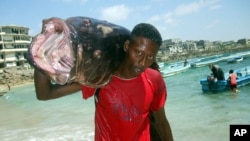
A Somali fisherman carries a fish called "Yapuri" as he walks from Hamarweyne beach in Mogadishu, Somalia, November 22, 2008.
MOMBASA, Kenya — Although the economic and human costs of piracy off the coast of Somalia are enormous, the pirates may actually be helping to improve marine life in the area. As commercial fishermen steer clear of the Somali coastline, fish and coral reefs thrive.
The cost of Somali piracy in 2011 was estimated between $6.6 and $6.9 billion, according to the One Earth Future Foundation. And, the United Nations says that, although the number of incidents declined in 2011, there were still 265 hostages being held at the end of the year.
Needless to say, many fishermen are avoiding Somali waters. But some of those who are venturing in say the fishing is quite good.
Abdul Mohammed Omar is a 24-year-old fisherman from Lamu, a Kenyan coastal town about 150 kilometers from the Somalia border. He was on a fishing expedition in Kiunga, next to the border, about six months ago. Omar claims that larger schools of fish are found closer to Somalia.
“The thing is, the other side, the border near to Somalia, is much better for fishing.
"But we’ve got no choice for [because of] these pirates," he said. "So we have to come this side. So now is not so good, because this side, there is not a lot of fish. People they are fishing a lot on this side. So right now, our business is very down, because we don’t get a lot of fish for now.”
Mudhir Abdulrahman is another Lamu fisherman who was in Somalia three months ago. He says that he does not go often, because of piracy fears, but that when he does, his catches are bigger.
“Before, we used to take three to four days to fill the boat with five tons of fish. But now, we go there for one day and we have five tons,” said Abdulrahman.
But it is not just the smaller fishermen who are afraid to venture into these waters. Alejandro Anganuzzi is the executive secretary of the Indian Ocean Tuna Commission, based in the Seychelles. He explains why there is very little activity there.
“Up to 200 miles [320 kilometers] from the coastline of Somalia, they haven’t had activities for a long time," said Anganuzzi. "Essentially, also because it would be an invitation to disaster for any boats right now to operate in that area. Some of the boats have security on-board, but they have very clear instructions from their flag states not to operate in any areas closer to 300 miles [480 kilometers].”
Large commercial fishing is restricted and local fishing has never been a major contributor to the Somali economy, which instead favors pastoral livestock and crop production. According to the Food and Agriculture Organization, the pastoral population is estimated at 2.3 million people, while coastal fishing only engages about 180,000 people.
“Fishing has never been that developed along the main, sort of the Indian Ocean, Somali coast," said Obura. "So small-scale fishing can happen, with artisanal gears and very basic gears. But until you get a really supportive economic and business environment, for people to invest in large boats and the gear and the fuel that’s needed to run them, and the expertise, fishing doesn’t develop as a major economic sector until there is a good supportive environment for it.”
Obura says that he expects reef fish populations to be quite healthy, based on marine research he did in Somaliland in 1997.
“But I’m guessing that now, with the conflict and the insecurity for boats on the sea, that there would be much less fishing in southern Somalia," he said. "And, when that happens for several years, you will get better fish communities. The reefs, themselves, all the reefs in East Africa are recovering from major bleaching events in 1998, so climate change impacts, so the corals may be in varied condition, but the fish will recover quite quickly if there’s no fishing pressure.”
However, Anganuzzi says that, although a form of marine conservation may be occurring in the waters near Somalia, the fishing vessels are simply relocating.
“Those fishing operations have disappeared from the tropical area. But, I think they have not disappeared altogether. So what you see is not a reduction in the fishing intensity, but rather a displacement. So what is good for some species in the tropical areas is going to be very bad for species in other areas, like the southern Indian Ocean, or even in other oceans,” he said.
But, as for the fish near the Somalia coastal areas, Lamu fisherman Omar says that the pirates are protecting them.
“Pirates take care after the fish. If somebody comes to catch, he has to go back because he’s afraid of the pirates. So the fish, they’re very lucky, to be honest,” he said.
Stretching more than 3,300 kilometers, Somalia has the longest coastline of any country in continental Africa. A 2011 U.N. Security Council report estimates that fisheries within 370 kilometers off the Somalia coast are capable of providing sustainable annual catches of at least 200,000 tons, including high-value tuna and mackerel.