


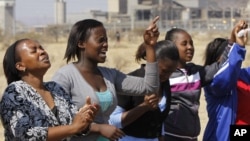
WONDERKOP, South Africa — South Africa is still reeling after a shootout between police and striking miners left 34 people dead last Thursday. That episode at a platinum mine rocked world markets. But in South Africa, the incident could also signal a major social shift in a nation that is still coming out of the shadow of apartheid.
"Violence." "War." "Massacre."
Those are just some of the headlines in South African newspapers days after police and angry miners confronted each other at a platinum mine, leading to a deadly shootout.
Thursday's incident at the Lonmin platinum mine has reverberated throughout Africa’s largest economy, and internationally as well.
After more than a week of violence there are now 42 dead workers, two dead policemen and a burning question: what does this mean for South Africa's biggest industry, and its people?
Professor Adam Habib, deputy vice chancellor of the University of Johannesburg, says the event has prompted an “existential crisis” among South Africans nearly two decades after the end of apartheid.
“I think this also provokes a crisis for who we are, the levels of inequality in our society, how is it that this brings to the fore so graphically how the third-biggest provider of platinum in the world, Lonmin, located in the JSE [Johannesburg Stock Exchange] and the London stock exchange, which pays its CEO and executives exorbitant amounts of money, and yet the very people who dig platinum out of the ground live in the most awful of conditions. The conditions, how women are treated, all of these things, suggest that this society is riven by inequality," he said. "How can you, after 18 years after the democratic transition, not address the basic elements of this kind of stuff?”
“I think this also provokes a crisis for who we are, the levels of inequality in our society, how is it that this brings to the fore so graphically how the third-biggest provider of platinum in the world, Lonmin, located in the JSE [Johannesburg Stock Exchange] and the London stock exchange, which pays its CEO and executives exorbitant amounts of money, and yet the very people who dig platinum out of the ground live in the most awful of conditions. The conditions, how women are treated, all of these things, suggest that this society is riven by inequality," he said. "How can you, after 18 years after the democratic transition, not address the basic elements of this kind of stuff?”
Unrest began last week when 3,000 workers walked out over a pay dispute. Over the next few days, eight workers and two policemen were killed in clashes. The shootout on Thursday killed 34 more.
In South Africa, considered one of Africa’s most stable nations, the Sowetan newspaper warned in an editorial that the nation could "see a snowball effect of this massacre.”
The Timeslive website said the scenes were “horrifyingly familiar”, a reference to apartheid-era standoffs between black protesters and police.
Internationally, the price of the precious metal jumped; the company's share price dipped.
Most of the workers at the Lonmin mine make about $500 a month. During Thursday’s incident, miners asked for a raise to $1,500 a month.
That amount is just enough to buy one ounce of platinum at today’s market price of about $1,470.
Mining has been a mixed blessing for South Africa. It provided the riches that founded Johannesburg, also known as Egoli, the place of gold. The industry employs hundreds of thousands of people, most of them menial black workers.
South Africa remains an economically divided society. Wonderkop, the town next to the Lonmin mine, is desperately poor despite the riches beneath the ground. Most residents of Wonderkop live in dusty corrugated-metal shacks. Most roads are unpaved.
The biggest, nicest buildings are churches, where many residents gathered Sunday morning.
Like most residents, Daniel Modisenyane has links to the mine, he has siblings working there. The 54-year-old lay preacher says the event affected the entire community. “This is very devastating, this is very mind disturbing, this is a shock. according to my observation, what has transpired is really out of order. This is not the way people should treat, and it’s not the way that companies should treat their employees," he said.
Another churchgoer works at the mine, and asked to be identified only by his first name, Thabo.
Thabo says he was with his fellow miners during the confrontation and that four or five of his friends were shot. He says he earns less than $200 a month and that he thinks the request for about $1,500 was reasonable.
A friend who helped translate says Thabo would like to see Lonmin come back to the bargaining table. "It's no good, the mine problem is no good. They want money. Management must sit down and speak to some of the people," he said.
Wonders Ntshaqa, who has worked at the mine for more than three decades, says he wants more answers from the government. He blames both sides for the violence which has left him traumatized and unable to sleep. "I don't know who is right, who is wrong, what is happening, who is starting [it], what is the right thing, what is the wrong thing. If I want something, to do a good something, I must be sitting down, I am looking for a solution, the solution is not a fight, the solution is not to kill the people," he said.
The government has ordered an investigation.
But until then, this mining community is seeking answers from a higher power.