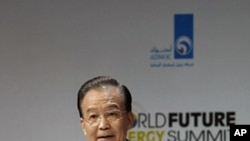



Two of Asia’s top leaders have called for the international community to do more to promote sustainable energy amid fears that tighter sanctions on Iran could affect global oil supplies.
Speaking at an energy summit in Abu Dhabi, Chinese Premier Wen Jiabao and South Korean Prime Minister Kim Hwang-Sik both implied the world has become too dependent on fossil fuels.
Both men have been in the Persian Gulf trying to secure oil imports as sanctions on Iran, and Tehran’s subsequent threat to close the Strait of Hormuz, pose a threat to their growing economies. Roughly 40 percent of oil shipped worldwide passes through the strategic waterway.
China’s Wen indicated that many ongoing political, economic and environmental problems could eventually be solved, in part, by alternative energy.
He urged international cooperation in developing a stable, economical, and safe energy supply system that would help eliminate economic inequality caused by energy and resources.
Prime Minister Kim told the audience in Abu Dhabi that nuclear power should be an important energy source in the post-oil era. He advocated the peaceful use of nuclear energy in developed and developing countries.
Kim’s comments were made after the United States and Europe agreed to sanctions on Iran’s oil industry, hoping the move would force the country to abandon its nuclear program. The West is convinced the program is aimed at building weapons, but Tehran says it is solely for energy purposes.
Despite calls from the United Sates, Asian nations have yet to announce any cuts in their crude imports from Iran.
A visit by Premier Wen to Saudi Arabia this week followed an announcement by Saudi officials that they were prepared to meet any oil shortage that may arise from new sanctions on Iran. Iran has warned Gulf nations against boosting their production.
Neither Mr. Wen nor Mr. Kim will be visiting Iran during their current trips to the Middle East.
South Korea, China Call for Cooperation on Sustainable Energy