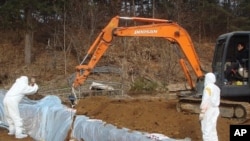
South Korean officials say vaccinations and quarantine efforts are stemming the country’s worst-ever outbreak of foot-and-mouth disease. Since late November, nearly 1.7 million cloven-hoofed animals have been culled. Animal rights activists are upset - saying most of those pigs and cows have been buried alive.
South Korea’s Ministry for Food, Agriculture, Forestry and Fisheries says it is gaining the upper hand in the battle against a highly contagious animal disease. The outbreak has decimated the country's livestock and cost farmers more than $1 billion in the past month-and-a-half.
Officials say only a few new cases of foot-and-mouth disease have been reported in the past several days. But the outbreak has overwhelmed veterinarians and public officials. Farmers say it will take years to recover financially.
Nearly 1.7 million animals have been destroyed, so far. South Korea, before the culling began, had a total 10 million swine and three million cattle.
Animal rights activists say most of the pigs and cows ordered destroyed have been buried alive.
Lee Won-bok, the president of South Korea’s Association for Animal Protection, says culling in this manner is illegal and inhumane, but those in the industry do not seem to have any compassion. He has been demanding authorities cease live burials and keep the number of animals culled to minimum.
Lee says he witnessed pigs being flung into five-meter deep pits, causing injuries before they eventually died of suffocation. He says he has been hearing the squeals of their suffering echoing in his ears for more than two weeks.
Lee Byoung-guan is the deputy director of the National Veterinary Research and Quarantine Service. He says central government authorities never ordered live burials.
Lee says it appears local authorities made their own decisions to kill the animals in this manner.
The government veterinarian predicts that, as a result of widespread quarantine and aggressive vaccinations, the number of cases should be minimized by the end of this month.
There has been criticism about the delay in ordering mass vaccinations. One factor, critics say, is because it has been quicker and cheaper to kill the animals than to vaccinate them.
Another factor is that blood tests cannot distinguish between infected and vaccinated livestock. That would prevent livestock from being exported until South Korea could be re-designated as disease-free by the World Organization for Animal Health.
South Korea’s president on Sunday traveled to the east of the capital, Seoul, to inspect quarantine activities against foot-and-mouth disease. Lee Myung-bak called on civil servants to do whatever it takes to halt the spread of the disease, which also hit the country twice last year.
The scope of this outbreak is the largest yet in the country and comes ahead of the Lunar New Year holidays next month, during which it is traditional to give gifts of meat.
Foot-and-mouth disease, while highly infectious among cloven-hoofed animals, does not affect humans.
South Korea is also fighting avian influenza. Since New Year’s Eve, there have been more than 25 confirmed outbreaks at poultry farms, resulting in the culling and burial of three-and-a-half million ducks and chickens.
Bird flu poses a greater public health concern than foot-and-mouth disease. The H5N1 virus is capable of infecting humans, mainly through contact with infected poultry. Experts worry the strain of influenza could mutate, leading to a global human influenza pandemic.
South Korea Claiming Upper Hand in Farm Battle Against Foot-and-Mouth Disease