



SEOUL - South Korea's military is declaring it is ready for any provocation from Pyongyang, amid increased activity by North Korean fighter jets.
South Korea's joint chiefs of staff Thursday said it is "closely paying attention to North Korean movements" after a significant number of sorties by North Korean jets near South Korean airspace in the past several weeks.
A spokesman for the joint chiefs would not release specific details about the activity. But sources say the North Korean jets have been making dozens of daily sorties with several approaching what is known as the Tactical Action Line. That is the point between 20 and 50 kilometers north of South Korean airspace. Any aircraft approaching that line compels fighter jets in the South to scramble.
An official at the Defense Ministry, speaking to VOA News on condition he not be named, says none of the North Korean jets entered South Korean airspace. But an hour-long flight Tuesday by a North Korean SU-25 fighter prompted South Korea to dispatch four jets. The fighter, capable of a top speed of 950 kilometers an hour, approached South Korea's Gangwha island, just north of Incheon International Airport, and then spent several minutes over the border city of Kaesong before returning north.
In a South Korean Memorial Day speech at the National Cemetery, President Lee Myung-bak did not directly refer to the previous day's provocative flight but advised Pyongyang to be cautious.
President Lee says South Korea has an impregnable security posture and will safeguard peace on the peninsula by responding to any provocation with strict punishment.
Kim Jong Un's address
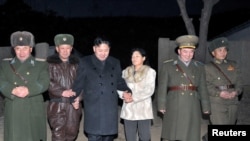
On the same day, 200 kilometers to the North, the new leader in Pyongyang, Kim Jong Un, appeared before an audience of thousands of schoolchildren and gave his second public speech since assuming power last year.
Kim says the children "should become young revolutionaries and young vigilantes and dare death" to protect the workers' party.
Earlier this week, the general staff of the North's Korean People's Army threatened to attack conservative media firms in Seoul for perceived insults against the new North Korean leader. Pyongyang warned unless an apology is forthcoming South Korea faces "a merciless sacred war."
Although such belligerent rhetoric is common, some analysts say Pyongyang is demonstrating it is now moving beyond words. They also note recent jamming of satellite navigation signals blamed on North Korea, which affected commercial jets and ships in the South.
Show of loyalty?
Analysts contend a military provocation might come from the North as part of the process by forces there to demonstrate loyalty to Kim and show he is as capable and tough as his late father and grandfather, the repressive country's only other leaders.
A senior researcher at the Korea Institute for Defense Analyses, Park Dae-kwang, says the increased fighter jet flights are related to this.
Park says the sorties approaching the Tactical Action Line appear linked to recent threatening rhetoric from Pyongyang. But he says North Korea's air force is severely constrained by fuel shortages.
Although North Korea has long been able to claim a much larger-sized air force than South Korea's, analysts note that - with the exception of several MiG-29's - its planes are old, they lack advanced weapons and their pilots do not get adequate training.
South Korea has more than 500 fighter jets, most of them American-made.
South Korea also enjoys the advantage of the presence of the U.S. 7th Air Force. Its main combat assets are the F-16 and A-10 squadrons of the forward-deployed 51st Fighter Wing at Osan Air Base and advanced F-16s at Kunsan Air Base.
South Korea's joint chiefs of staff Thursday said it is "closely paying attention to North Korean movements" after a significant number of sorties by North Korean jets near South Korean airspace in the past several weeks.
A spokesman for the joint chiefs would not release specific details about the activity. But sources say the North Korean jets have been making dozens of daily sorties with several approaching what is known as the Tactical Action Line. That is the point between 20 and 50 kilometers north of South Korean airspace. Any aircraft approaching that line compels fighter jets in the South to scramble.
An official at the Defense Ministry, speaking to VOA News on condition he not be named, says none of the North Korean jets entered South Korean airspace. But an hour-long flight Tuesday by a North Korean SU-25 fighter prompted South Korea to dispatch four jets. The fighter, capable of a top speed of 950 kilometers an hour, approached South Korea's Gangwha island, just north of Incheon International Airport, and then spent several minutes over the border city of Kaesong before returning north.
In a South Korean Memorial Day speech at the National Cemetery, President Lee Myung-bak did not directly refer to the previous day's provocative flight but advised Pyongyang to be cautious.
President Lee says South Korea has an impregnable security posture and will safeguard peace on the peninsula by responding to any provocation with strict punishment.
Kim Jong Un's address
On the same day, 200 kilometers to the North, the new leader in Pyongyang, Kim Jong Un, appeared before an audience of thousands of schoolchildren and gave his second public speech since assuming power last year.
Kim says the children "should become young revolutionaries and young vigilantes and dare death" to protect the workers' party.
Earlier this week, the general staff of the North's Korean People's Army threatened to attack conservative media firms in Seoul for perceived insults against the new North Korean leader. Pyongyang warned unless an apology is forthcoming South Korea faces "a merciless sacred war."
Although such belligerent rhetoric is common, some analysts say Pyongyang is demonstrating it is now moving beyond words. They also note recent jamming of satellite navigation signals blamed on North Korea, which affected commercial jets and ships in the South.
Show of loyalty?
Analysts contend a military provocation might come from the North as part of the process by forces there to demonstrate loyalty to Kim and show he is as capable and tough as his late father and grandfather, the repressive country's only other leaders.
A senior researcher at the Korea Institute for Defense Analyses, Park Dae-kwang, says the increased fighter jet flights are related to this.
Park says the sorties approaching the Tactical Action Line appear linked to recent threatening rhetoric from Pyongyang. But he says North Korea's air force is severely constrained by fuel shortages.
Although North Korea has long been able to claim a much larger-sized air force than South Korea's, analysts note that - with the exception of several MiG-29's - its planes are old, they lack advanced weapons and their pilots do not get adequate training.
South Korea has more than 500 fighter jets, most of them American-made.
South Korea also enjoys the advantage of the presence of the U.S. 7th Air Force. Its main combat assets are the F-16 and A-10 squadrons of the forward-deployed 51st Fighter Wing at Osan Air Base and advanced F-16s at Kunsan Air Base.