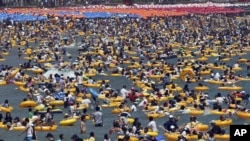
SEOUL — Police in South Korea's second largest metropolitan area are blaming foreigners, mainly Asian migrant workers, for committing an increasing number of crimes on one of the country's most popular beaches.
The police station at Haeundae beach has sent a letter to 1,600 companies in the Busan area asking for their help in preventing their foreign employees from breaking the law.
The letter, dated July 10, asserts that during the summer vacation season foreigners “who drink and sleep in the park near the beach” are causing “many problems.” The letter also acknowledges that cultural misunderstandings may be exacerbating the situation.
A policeman at the Haeundae beach station denied any unfounded discrimination against foreigners explaining there are “many cases” involving foreigners. He spoke to VOA News on condition he not be named.
South Korea is largely ethnically homogeneous, but the government has been pushing to embrace multiculturalism with more than 500,000 foreign workers legally in the country. Critics say the government still has policies that unfairly target foreigners, such as mandatory HIV and drug tests for foreign English teachers.
Beach Worries
On South Korea’s popular southeast coast, long-time visitors to Haeundae beach say they have noticed an increase in the number of foreigners in recent years. That is due, in part, police say, to busloads of migrant workers being dropped off at the beach by their companies during their summer holiday break.
An official at the National Police Agency, who did not want to be named, denied a report by the Busan Ilbo that officers in Busan had asked the hundreds of companies employing foreigners to keep them away from the 1.5 kilometer-long beach at the southeastern end of the city, one of South Korea's most popular destinations for families and students during the holiday season.
The police have printed materials for foreigners in Chinese, Vietnamese, Bahasa Indonesia and English for distribution in the Busan area, home to 4.4 million people, explaining how “cultural differences” can lead to them being arrested.
A separate advisory, circulated by the Human Resources Development Service of Korea to companies and posted online, alerts foreigners about the punishments for sexual assault and molestation convictions. It also warns against littering, public urination, rowdy behavior, damaging nature and taking photographs of people on the beach without their permission. It notes these same rules apply to South Korean citizens as well.
The incidents appear to be sensitive matter in Busan. Police, the city government and rights groups representing migrant workers in the area all declined requests for on-the-record interviews this week.
Foreigners Arrested
The Yonhap news agency says a Bangladeshi and a Vietnamese national on Monday were apprehended for allegedly molesting teenaged girls, while a Burmese was detained after he was accused of taking close-up photographs of bikini-clad beach-goers.
During the previous week, police say they arrested two Vietnamese and a Pakistani civil servant for secretly taking similar pictures.
Authorities are approaching the matter carefully for fear their “guidance activities” aimed at foreign laborers could ignite a racism debate, writes Robert Koehler, an American, in an article titled Will the Foreigners PLEASE Stop Molesting Women at the Beach, in his popular weblog The Marmot's Hole.
Groups involved with migrant laborers say there may be several hundred thousand additional undocumented workers in the country.
Most migrant laborers in South Korea are from Thailand, the Philippines, Bangladesh and Vietnam. The majority of those legally employed work under government-to-government contracts in local industrial sectors.
Busan is the busiest trans-shipment port in Northeast Asia and its other flagship industries include steel and automobile parts manufacturing.
Youmi Kim also contributed to this report.
The police station at Haeundae beach has sent a letter to 1,600 companies in the Busan area asking for their help in preventing their foreign employees from breaking the law.
The letter, dated July 10, asserts that during the summer vacation season foreigners “who drink and sleep in the park near the beach” are causing “many problems.” The letter also acknowledges that cultural misunderstandings may be exacerbating the situation.
A policeman at the Haeundae beach station denied any unfounded discrimination against foreigners explaining there are “many cases” involving foreigners. He spoke to VOA News on condition he not be named.
South Korea is largely ethnically homogeneous, but the government has been pushing to embrace multiculturalism with more than 500,000 foreign workers legally in the country. Critics say the government still has policies that unfairly target foreigners, such as mandatory HIV and drug tests for foreign English teachers.
Beach Worries
On South Korea’s popular southeast coast, long-time visitors to Haeundae beach say they have noticed an increase in the number of foreigners in recent years. That is due, in part, police say, to busloads of migrant workers being dropped off at the beach by their companies during their summer holiday break.
An official at the National Police Agency, who did not want to be named, denied a report by the Busan Ilbo that officers in Busan had asked the hundreds of companies employing foreigners to keep them away from the 1.5 kilometer-long beach at the southeastern end of the city, one of South Korea's most popular destinations for families and students during the holiday season.
The police have printed materials for foreigners in Chinese, Vietnamese, Bahasa Indonesia and English for distribution in the Busan area, home to 4.4 million people, explaining how “cultural differences” can lead to them being arrested.
A separate advisory, circulated by the Human Resources Development Service of Korea to companies and posted online, alerts foreigners about the punishments for sexual assault and molestation convictions. It also warns against littering, public urination, rowdy behavior, damaging nature and taking photographs of people on the beach without their permission. It notes these same rules apply to South Korean citizens as well.
The incidents appear to be sensitive matter in Busan. Police, the city government and rights groups representing migrant workers in the area all declined requests for on-the-record interviews this week.
Foreigners Arrested
The Yonhap news agency says a Bangladeshi and a Vietnamese national on Monday were apprehended for allegedly molesting teenaged girls, while a Burmese was detained after he was accused of taking close-up photographs of bikini-clad beach-goers.
During the previous week, police say they arrested two Vietnamese and a Pakistani civil servant for secretly taking similar pictures.
Authorities are approaching the matter carefully for fear their “guidance activities” aimed at foreign laborers could ignite a racism debate, writes Robert Koehler, an American, in an article titled Will the Foreigners PLEASE Stop Molesting Women at the Beach, in his popular weblog The Marmot's Hole.
Groups involved with migrant laborers say there may be several hundred thousand additional undocumented workers in the country.
Most migrant laborers in South Korea are from Thailand, the Philippines, Bangladesh and Vietnam. The majority of those legally employed work under government-to-government contracts in local industrial sectors.
Busan is the busiest trans-shipment port in Northeast Asia and its other flagship industries include steel and automobile parts manufacturing.
Youmi Kim also contributed to this report.