


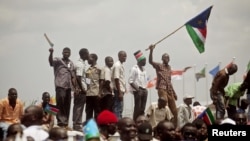
NAIROBI — Next Monday, South Sudan will celebrate its first year of independence. Many challenges face the young nation, including an ill-defined and violent border with Sudan, internal conflicts in the Greater Upper Nile region, and a looming economic crisis.
A year ago today, hopes were high for Africa’s newest nation. After more than two decades of war, South Sudan officially seceded from Sudan.
Giell Deng, a South Sudanese musician, is looking forward to Monday, the first anniversary of independence.
"It’s one year old, it’s a new nation, so guys they still have the spirit that they are more excited because we have been at war for decades," said Deng.
Though the 21-year war with Sudan officially ended with the signing of the Comprehensive Peace Agreement in 2005, new battles face the fledgling government in Juba.
These challenges include an economic crisis, clashes and cattle raids in Jonglei State, and a violently contested border with Sudan.
In January, Juba shut down its oil production in protest of the taxes levied by Khartoum for use of Sudan’s pipeline. Before this, South Sudan derived 98 percent of its revenue from oil exports.
Analysts believes that despite austerity measures taken by the government in Juba, the deficit is so great that it may be difficult to pay the salaries of the large and heavily armed military. Much of the army is posted near the uneasy border with Sudan.
Amnesty International and Human Rights Watch both found serious human rights violations in the new South Sudan.
"Basically we didn’t see a lot of progress in the first year on the human rights priorities. There has been some work done by the government in the legislature drafting relevant laws, which are important and helpful, but not enough has been done," said Jihan Henry, a New York-based HRW analyst.
A HRW report released in June described a deeply flawed justice system, including large numbers of unlawful detentions and dire prison conditions.
"The very serious intercommunal violence that we saw in Jonglei state earlier this year really underscores the importance of improving accountability mechanisms throughout the country," said Henry. "Not only for mass crimes, and these intercommunal conflicts should be treated as crimes, not only for crimes but also for human rights violations that are carried out by the soldiers and police."
Juba has deployed South Sudan’s armed forces to fight at least seven armed opposition groups in Jonglei, Unity, and Upper Nile states. Civilian settlements have been destroyed in indiscriminate insurgency and counter-insurgency attacks. The violence has also exacerbated a food crisis in the region.
Despite the realization of independence, the future of South Sudan is still inextricably linked to that of its northern neighbor.
The government in Khartoum, now facing frequent protests over high prices, is fighting an insurgency in Southern Kordofan and Blue Nile states along the border. The rebel group SPLM-North, which sided with the south during Sudan's civil war, has been fighting for more than a year and has made an alliance with rebels in Sudan's Darfur region.
Hundreds of thousands of Sudanese have fled to Unity and Upper Nile states in South Sudan, further destabilizing the border region.
"In terms of settling the conflict there, what is absolutely critical today is for the international community to apply diplomatic pressure to the government of Sudan to initiate negotiations with the SPLM-N and as well with the broader coalition, called the Sudan Revolutionary Front," said Jenn Christian, a Sudan Analyst with the D.C.-based Enough Project.
The government in Khartoum accuses the government in Juba of supporting the SPLM-North and its insurgency, frustrating any negotiations between the states.
At a distance in Nairobi, Giell Deng remains optimistic. On Monday he is performing in a concert to celebrate the anniversary.
"Though we still have these small crises about the borders, time-by-time we will be okay," said Deng.
The question remains, how much time will pass before the crises are resolved?
A year ago today, hopes were high for Africa’s newest nation. After more than two decades of war, South Sudan officially seceded from Sudan.
Giell Deng, a South Sudanese musician, is looking forward to Monday, the first anniversary of independence.
"It’s one year old, it’s a new nation, so guys they still have the spirit that they are more excited because we have been at war for decades," said Deng.
Though the 21-year war with Sudan officially ended with the signing of the Comprehensive Peace Agreement in 2005, new battles face the fledgling government in Juba.
These challenges include an economic crisis, clashes and cattle raids in Jonglei State, and a violently contested border with Sudan.
In January, Juba shut down its oil production in protest of the taxes levied by Khartoum for use of Sudan’s pipeline. Before this, South Sudan derived 98 percent of its revenue from oil exports.
Analysts believes that despite austerity measures taken by the government in Juba, the deficit is so great that it may be difficult to pay the salaries of the large and heavily armed military. Much of the army is posted near the uneasy border with Sudan.
Amnesty International and Human Rights Watch both found serious human rights violations in the new South Sudan.
"Basically we didn’t see a lot of progress in the first year on the human rights priorities. There has been some work done by the government in the legislature drafting relevant laws, which are important and helpful, but not enough has been done," said Jihan Henry, a New York-based HRW analyst.
A HRW report released in June described a deeply flawed justice system, including large numbers of unlawful detentions and dire prison conditions.
"The very serious intercommunal violence that we saw in Jonglei state earlier this year really underscores the importance of improving accountability mechanisms throughout the country," said Henry. "Not only for mass crimes, and these intercommunal conflicts should be treated as crimes, not only for crimes but also for human rights violations that are carried out by the soldiers and police."
Juba has deployed South Sudan’s armed forces to fight at least seven armed opposition groups in Jonglei, Unity, and Upper Nile states. Civilian settlements have been destroyed in indiscriminate insurgency and counter-insurgency attacks. The violence has also exacerbated a food crisis in the region.
Despite the realization of independence, the future of South Sudan is still inextricably linked to that of its northern neighbor.
The government in Khartoum, now facing frequent protests over high prices, is fighting an insurgency in Southern Kordofan and Blue Nile states along the border. The rebel group SPLM-North, which sided with the south during Sudan's civil war, has been fighting for more than a year and has made an alliance with rebels in Sudan's Darfur region.
Hundreds of thousands of Sudanese have fled to Unity and Upper Nile states in South Sudan, further destabilizing the border region.
"In terms of settling the conflict there, what is absolutely critical today is for the international community to apply diplomatic pressure to the government of Sudan to initiate negotiations with the SPLM-N and as well with the broader coalition, called the Sudan Revolutionary Front," said Jenn Christian, a Sudan Analyst with the D.C.-based Enough Project.
The government in Khartoum accuses the government in Juba of supporting the SPLM-North and its insurgency, frustrating any negotiations between the states.
At a distance in Nairobi, Giell Deng remains optimistic. On Monday he is performing in a concert to celebrate the anniversary.
"Though we still have these small crises about the borders, time-by-time we will be okay," said Deng.
The question remains, how much time will pass before the crises are resolved?