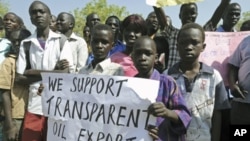



South Sudan is shutting down its oil production to protest against high fees Sudan charges to transport the commodity through northern pipelines. The move threatens both countries' economies and is heightening tensions that have festered since the south declared independence in July.
The government of South Sudan says it already has cut oil output in the country by more than half and plans to continue reducing outflows unless Sudan meets its demands.
South Sudan had shut down most of its wells by the end of the day Tuesday in the north central parts of the country. The process is continuing in Upper Nile state in the east, home to the bulk of the country's oil fields.
Continuing conflict
The shutoff is the latest development of an ongoing dispute between the two Sudans on how to share oil revenues following their split last year.
South Sudan claims the north has confiscated $815 million in oil from the south. Khartoum says it took the oil to compensate for lost revenues.
Sudan also is charging the south transit fees as high as $36 per barrel - far above the industry standard - which is closer to $1 per barrel.
South Sudan's Petroleum and Mining Minister Stephen Dhieu Dau says that Khartoum's terms are unacceptable.
“We also have been paying the operation costs for the pipeline and marine terminal and covering all these facilities. But Khartoum, unfortunately, is imposing punitive fees, discriminatory fees, against South Sudan as a penalty for the secession,” said Dau.
Heavy reliance on oil money
More than 90 percent of South Sudan's revenues are derived from oil exports. The country, at its creation, inherited three-quarters of the known oil reserves in the former united Sudan. The separation is said to have cost Khartoum more than $7 billion in lost revenue.
While South Sudan produces the bulk of the crude oil, though, it has no refining capacity, and relies on northern pipelines to export.
The move to shutdown the pipelines will cost both countries economically, but Dau said the south has considered the alternatives.
“You will come to one answer. Either you produce, you get zero - or you shut down, you get zero and Khartoum gets zero,” said Dau.
AU summit negotiations
The leaders of the two Sudans are expected to meet on the sidelines of the African Union summit in the Ethiopian capital Addis Ababa. An AU panel that has been mediating the negotiations submitted a new draft proposal this week to resolve the dispute.
Dana Wilkins, a campaigner at Global Witness, a natural resources monitoring group, said the south has a lot to lose if its gambit does not work.
“South Sudan in particular is going to feel the hit on revenues pretty quickly. It's not clear just how much they have in savings, but what is clear is that they're going to have to rely heavily on the international community for financial support over the coming year if this shutdown happens in full and the negotiations don't come to at least an interim arrangement,” said Wilkins.
South Sudan is exploring alternative transit routes for its oil. The government announced this week it has struck a deal with Kenya for a new pipeline stretching to the town of Lamu on the Indian Ocean. But it was not clear when the pipeline may be started or finished.
South Sudan Gambles Big With Oil Shutdown
- By Gabe Joselow