


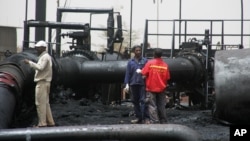
NAIROBI — Brave or reckless, South Sudan's decision to shut down its oil production to protest the north has had disastrous consequences for its citizens. The country's economy came to a jarring halt in January, when it shut down oil production due to a trade dispute with Sudan.
To make up for its own lost revenues from the split with South Sudan, Khartoum had been demanding exorbitant transit fees for the use of its pipelines and port, the only available route for South Sudan to export its oil.
Anne Itto, Deputy Secretary of South Sudan's ruling party, the SPLM, says the south has refused to resume production until Sudan agrees to more reasonable terms.
"Khartoum was asking $36 per drum, which is very unusual and is not practicable," said Itto. "If south Sudan ever accepts to pay such rent, it is like giving away our oil, as well."
When the pumps came to a stop, South Sudan had lost the source of 98 percent of its annual revenue.
Already one of the poorest nations in the world, ranking at the bottom of every list of human development, the government has announced austerity measures to cope with the loss.
The Secretary-General of South Sudan's Chamber of Commerce Simon Akwei Deng, speaking at a debate sponsored by the BBC, says the shutdown has crippled the country's nascent private sector.
"It is not for the interests of the common citizens and the interests of the business people that these borders should be closed," said Deng. "It should be open because this is our fundamental rights to trade between ourselves, respecting the idea of globalization of trade between countries."
The loss of foreign revenue pushed the annual inflation rate up to 80 percent in May. Meanwhile, the exchange rate for the South Sudanese pound has tripled against the dollar on the black market, greatly increasing the cost of living.
In the past, the southern republic has been buoyed by its international partners. The United States provided more than $400 million in bilateral assistance to South Sudan in 2011.
U.S. Special Envoy for Sudan and South Sudan, Princeton Lyman, said that the oil shutdown has threatened development and is forcing donors to reassess their priorities.
"There is a serious problem in maintaining the gains in education and health over the last six years and of maintaining basic services," said Lyman. "All the donor countries now have to reconsider whether they can sustain development investments like feeder roads and things like that, but will have to shift to more emergency assistance such as food and basic medicines."
Lyman says nearly three million people in South Sudan are in need of food assistance, which is about 30 percent of the population.
The United Nations has voiced concern that the government's austerity measures will further hurt the poorest of the poor, by cutting services and leaving citizens with less money to spend on basic needs.
Humanitarian agencies have their hands full helping some 200,000 refugees that have fled to camps in the south to escape fighting in Sudan.
Chris Nikoi, the South Sudan Country Director for the World Food Program says the U.N. is appealing for over $1 billion in international humanitarian assistance this year, up from $663 million a year ago.
Billions of dollars of oil will remain trapped underground until South Sudan and Sudan can resolve the outstanding issues left over from their divorce. But border disputes and security concerns have dominated the African Union-mediated talks so far and agreement is nowhere in sight.
The gridlock has made many young people fear for their future.
Jambukokwen Morris studies computer engineering and telecommunications at Juba University. When he graduates, he says he hopes to start his own Internet technology business. But like many of his generation in South Sudan's capital, Morris is no longer as optimistic about his country's future as he once was.
"After the independence, from the beginning, I used to wake up early in the morning, I could see new things happening, you feel that there is movement, actually, things are changing," said Morris. "But now it's like things have come to [be] stagnant. Maybe it's because of the closing down of the oil, or what exactly, but I don't know.
Recent university graduate Hannah Nyongale says many of her peers have simply given up.
"I've seen [the] young men, they are just drinking. They are frustrated, but for women of course they will look for husbands who can take care of them," Nyongale noted. "I don't want to exaggerate, but too many… are just hopeless cases. Too many applications I've dropped in so many places without success."

To make up for its own lost revenues from the split with South Sudan, Khartoum had been demanding exorbitant transit fees for the use of its pipelines and port, the only available route for South Sudan to export its oil.
Anne Itto, Deputy Secretary of South Sudan's ruling party, the SPLM, says the south has refused to resume production until Sudan agrees to more reasonable terms.
"Khartoum was asking $36 per drum, which is very unusual and is not practicable," said Itto. "If south Sudan ever accepts to pay such rent, it is like giving away our oil, as well."
When the pumps came to a stop, South Sudan had lost the source of 98 percent of its annual revenue.
Already one of the poorest nations in the world, ranking at the bottom of every list of human development, the government has announced austerity measures to cope with the loss.
The Secretary-General of South Sudan's Chamber of Commerce Simon Akwei Deng, speaking at a debate sponsored by the BBC, says the shutdown has crippled the country's nascent private sector.
"It is not for the interests of the common citizens and the interests of the business people that these borders should be closed," said Deng. "It should be open because this is our fundamental rights to trade between ourselves, respecting the idea of globalization of trade between countries."
The loss of foreign revenue pushed the annual inflation rate up to 80 percent in May. Meanwhile, the exchange rate for the South Sudanese pound has tripled against the dollar on the black market, greatly increasing the cost of living.
In the past, the southern republic has been buoyed by its international partners. The United States provided more than $400 million in bilateral assistance to South Sudan in 2011.
U.S. Special Envoy for Sudan and South Sudan, Princeton Lyman, said that the oil shutdown has threatened development and is forcing donors to reassess their priorities.
"There is a serious problem in maintaining the gains in education and health over the last six years and of maintaining basic services," said Lyman. "All the donor countries now have to reconsider whether they can sustain development investments like feeder roads and things like that, but will have to shift to more emergency assistance such as food and basic medicines."
Lyman says nearly three million people in South Sudan are in need of food assistance, which is about 30 percent of the population.
The United Nations has voiced concern that the government's austerity measures will further hurt the poorest of the poor, by cutting services and leaving citizens with less money to spend on basic needs.
Humanitarian agencies have their hands full helping some 200,000 refugees that have fled to camps in the south to escape fighting in Sudan.
Chris Nikoi, the South Sudan Country Director for the World Food Program says the U.N. is appealing for over $1 billion in international humanitarian assistance this year, up from $663 million a year ago.
Billions of dollars of oil will remain trapped underground until South Sudan and Sudan can resolve the outstanding issues left over from their divorce. But border disputes and security concerns have dominated the African Union-mediated talks so far and agreement is nowhere in sight.
The gridlock has made many young people fear for their future.
Jambukokwen Morris studies computer engineering and telecommunications at Juba University. When he graduates, he says he hopes to start his own Internet technology business. But like many of his generation in South Sudan's capital, Morris is no longer as optimistic about his country's future as he once was.
"After the independence, from the beginning, I used to wake up early in the morning, I could see new things happening, you feel that there is movement, actually, things are changing," said Morris. "But now it's like things have come to [be] stagnant. Maybe it's because of the closing down of the oil, or what exactly, but I don't know.
Recent university graduate Hannah Nyongale says many of her peers have simply given up.
"I've seen [the] young men, they are just drinking. They are frustrated, but for women of course they will look for husbands who can take care of them," Nyongale noted. "I don't want to exaggerate, but too many… are just hopeless cases. Too many applications I've dropped in so many places without success."