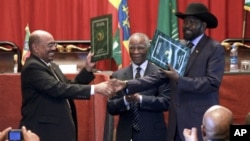
South Sudan’s vice president says the accords signed by Sudan and South Sudan last week in Ethiopia will relieve the economic hardship of people in both South Sudan and Sudan.
VOA spoke to Vice President Riek Machar in New York, shortly after he addressed the United Nations General Assembly. President Salva Kiir could not attend the U.N. debate because he was in the Ethiopian capital, Addis Ababa, where he signed the accords.
The vice president said the agreements will strengthen trade and stimulate economic activities between the two countries. He also noted that the agreements provide for the free movement of people between the two countries.
‘’South Sudanese can go north provided they have a legal document, similarly with north Sudanese. Trade across the borders will also flourish… before the blockade of the borders by Khartoum, we used to get more than 60 percent of our essential commodities from the north,” Machar said.
Machar said South Sudan’s decision to shut down oil production in January 2012 due to a disagreement with Khartoum over oil transport fees created hardships for the world’s newest country because the economy shrank and the government froze all development projects. South Sudan is almost entirely independent on oil revenue for hard currency and its oil must move through Sudanese pipelines to reach international markets.
‘’But it is a blessing that now there is an agreement to get more revenues particularly in hard currency and the people will be happy," said the vice president.
Machar acknowledged that economic stress created insecurity in South Sudan’s urban centers and a rise in people turning to “criminal activities,” but the government has created a combined force in Juba of police and security officials to fight crime.
An earlier version of this article had an incorrect date for when South Sudan shut down oil production.
VOA spoke to Vice President Riek Machar in New York, shortly after he addressed the United Nations General Assembly. President Salva Kiir could not attend the U.N. debate because he was in the Ethiopian capital, Addis Ababa, where he signed the accords.
The vice president said the agreements will strengthen trade and stimulate economic activities between the two countries. He also noted that the agreements provide for the free movement of people between the two countries.
‘’South Sudanese can go north provided they have a legal document, similarly with north Sudanese. Trade across the borders will also flourish… before the blockade of the borders by Khartoum, we used to get more than 60 percent of our essential commodities from the north,” Machar said.
Machar said South Sudan’s decision to shut down oil production in January 2012 due to a disagreement with Khartoum over oil transport fees created hardships for the world’s newest country because the economy shrank and the government froze all development projects. South Sudan is almost entirely independent on oil revenue for hard currency and its oil must move through Sudanese pipelines to reach international markets.
‘’But it is a blessing that now there is an agreement to get more revenues particularly in hard currency and the people will be happy," said the vice president.
Machar acknowledged that economic stress created insecurity in South Sudan’s urban centers and a rise in people turning to “criminal activities,” but the government has created a combined force in Juba of police and security officials to fight crime.
An earlier version of this article had an incorrect date for when South Sudan shut down oil production.