



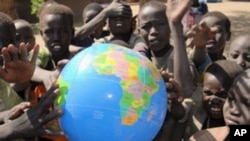
A new study says the challenges facing youth in South Sudan will prove a major obstacle to its development as an independent nation.
The report used Central Equatoria as a case study, and found that 38 percent of males and 58 percent of females, aged 15 to 19, have attended school.
South Sudan Vice-President Riek Machar attended the release of the report in Juba. He said his government will have to pay more attention to the plight of the youth if the new nation is to avoid the popular uprisings happening in the Arab World.
“Youths is engine of change, an engine of development, we have seen it in our lifetime when we created the SPLM/SPLA,” he said. “Without youth we wouldn’t have done it. Which we have seen also in the rest of the world, in particular now in the North and Middle East, changes are coming about because of youth and therefore any government will be interested to cater problems of youth. If it is a problem of employment, the government must be there to address such a problem.”
Researcher Natalie Forcier, from the organization Population Council, that created the report, said one reason that girls have even lower education rates than boys is because many girls are illegally married off and forced to quit school before they reach adulthood.
“Some of our key findings is that we have a lot of proportion of girls who are married before the legal age of 18, according to the 2008 Child Act,” she said. “The majority of those in school are not married, they know very little about young adults and reproductive choices and little is done about early marriages. It is things like health, poverty and education.”
The 2008 South Sudan census shows that 40 percent of women were married before turning 18 years of age, while 11percent were married before the age of 15.
Abak Rajab of the Coalition of Southern Sudan Civil Society Organizations (CASU) said changing these statistics will require changing how people think.
“On the issue of drop out of young girls in schools in Southern Sudan, I believe this is mainly a cultural issue,” he said. “We have a belief in most of our communities that a girl at the age of 14 is already mature and so can easily engage in sexual acts and when it comes to pregnancy, you find that they are not ready.”
Abak also blames the South Sudan government for not educating the population on the child act, which outlaws the marriage of girls under the age of 18.
“The government is not committing resources to enlighten the people on the law of the Child Act,” he said. “Because this law has to be popularized among the people, especially the local community leaders like chiefs. These are the people who have direct contact with the population. We have in some states the clash of cultural law and the national law.”
Isaiah Choi, of the Southern Sudan Center for Census, Statistics, and Evaluation, says surveys like this are necessary so that the government can plan proper social policies for the new country.
“The government can only address those issues when they are identified,” he said. “The problems of the youths may not necessarily be the same from the rural areas or in urban. They differ from one location to another, even among Counties there are bound to be differences. So unless we are able to assess their needs, the problems that are facing them, the government will not be able to make and form decisions. It is going to be an eye opener for our government not only at GoSS level, but at the state level, as well as at our county levels.”
Many youth in South Sudan are uneducated in part because of the more than 20 years of civil war with the north of Sudan, which made a normal childhood largely impossible. Many youth, even children, participated directly in the conflict as combatants.
The Minister of Youth, Sports and recreation Mr. Makwac Teng agrees that his government needs to do more.
“The Youth of South Sudan constitute a large part of the population and they have suffered gravely from the war and indeed were the primary actors and victims at the same time,” he said. “The scars of wars are still visible on them both physically and morally. The government of South Sudan has a responsibility to develop and empower the youths to allow them live to their full potential and make the effective contribution in all spheres of life, as individuals and as well as members of the wider society.”
The report argued that a low level of education among the youth will not only restrict their employment opportunities, but also leave the young men particularly vulnerable for recruitment into militias due to a lack of other opportunities.
Minister Teng said sports can help pull youth from negative influences.
“Through sports, the youth will acquire important skills for life, discipline, confidence, leadership, tolerance and cooperation,” he said. “Youth participation in sports will not only reduce the likelihood of disease, but indeed serve as an effective tool for youth mobilization against harmful habits such as drug abuse, crime and other anti-social habits.”
Youth in South Sudan make up 70 percent of the population, yet they have almost no representation in the state institutions, nor are there many jobs for them to find.
Already, disenchanted militia commanders have found it easy to recruit young men to fight in their rebellions. Often, all the youth have to be promised is food and the promise of a future position in the army, and they are ready to risk their lives fighting.