



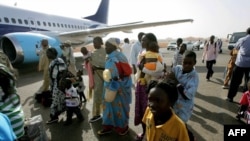
JUBA - A flight carrying the first group of South Sudanese nationals from Sudan landed in the capital Juba on Monday to cheering crowds.
Travel plans for these returnees changed several times due to fluctuations in north-south political relations. Both countries appeared set on returning to all-out war in recent weeks as armies clashed along the border.
Happy They're Home
Surrounded by excited groups who were there to greet the 164 passengers arriving from Sudan’s capital, Khartoum, Joseph Lual Acuil, Minister for Humanitarian Affairs, said South Sudan was very pleased to have them home.
"We are very happy and the president is also happy, that at least these citizens, the first batch has arrived safely," he said.
Between 12,000 and 15,000 South Sudanese have been stranded in Kosti refugee camp at a river port in Sudan's White Nile state. Many have been waiting to return to newly-independent South Sudan since it seceded from the north last year.
Many of the Kosti-based returnees will be bussed to Khartoum for Juba-bound flights in coming weeks.
Calling the stranded southerners a security threat, officials in Khartoum recently declared a state of emergency in White Nile and other border areas, ordering aid agencies out of the camps and giving all South Sudanese until May 5 to leave the country.
United Nations partners and the International Organization for Migration (I.O.M) responded to the demand by calling it an impossible task. Authorities in Khartoum also banned transportation by barge -- the primary means by which many South Sudanese were planning to return home -- saying that Juba was using the vessels to ferry troops to the border.
The international agencies then secured a May 20 deadline extension, but it was discarded once flights were organized.
Life in the North Wasn't Always Bad
Sisto Ceasar, a father of five, is returning to Juba after 14 years away.
“Life was not bad in the north, it’s only lately that it started getting bad," he said. "I’ve arrived home and I’m very happy. The environment looks interesting, and I’m trying to remember the years that I lived here in my youth."
Vince Houver, head of I.O.M. South Sudan, said flights will increase from two per day to eight per day in the next two weeks. The U.N. refugee agency, he added, is looking for a site to house returnees temporarily, until they can be matched up with belongings being trucked in from the North.
"People will be accommodated in transit for a number of weeks until they receive their luggage and are able to be sent to their final destination, mostly around Juba," he said.
Sudan President Omar al-Bashir and South Sudan President Salva Kiir were due to sign an agreement safeguarding rights of each other's citizens on April 3, but the ceremony was called off when clashes erupted along the border in the days leading up to the event.
The fighting quickly escalated into the most serious conflict between former civil war foes, and Sudan broke off African Union-led talks aimed at resolving issues of citizenship, oil revenues, borders and contested territory.
Up to half a million South Sudanese still face an uncertain future living in the north, as the U.N. and Africa Union urge the Sudans to return to negotiations and withdraw troops from border areas.
Travel plans for these returnees changed several times due to fluctuations in north-south political relations. Both countries appeared set on returning to all-out war in recent weeks as armies clashed along the border.
Happy They're Home
Surrounded by excited groups who were there to greet the 164 passengers arriving from Sudan’s capital, Khartoum, Joseph Lual Acuil, Minister for Humanitarian Affairs, said South Sudan was very pleased to have them home.
"We are very happy and the president is also happy, that at least these citizens, the first batch has arrived safely," he said.
Between 12,000 and 15,000 South Sudanese have been stranded in Kosti refugee camp at a river port in Sudan's White Nile state. Many have been waiting to return to newly-independent South Sudan since it seceded from the north last year.
Many of the Kosti-based returnees will be bussed to Khartoum for Juba-bound flights in coming weeks.
Calling the stranded southerners a security threat, officials in Khartoum recently declared a state of emergency in White Nile and other border areas, ordering aid agencies out of the camps and giving all South Sudanese until May 5 to leave the country.
United Nations partners and the International Organization for Migration (I.O.M) responded to the demand by calling it an impossible task. Authorities in Khartoum also banned transportation by barge -- the primary means by which many South Sudanese were planning to return home -- saying that Juba was using the vessels to ferry troops to the border.
The international agencies then secured a May 20 deadline extension, but it was discarded once flights were organized.
Life in the North Wasn't Always Bad
Sisto Ceasar, a father of five, is returning to Juba after 14 years away.
“Life was not bad in the north, it’s only lately that it started getting bad," he said. "I’ve arrived home and I’m very happy. The environment looks interesting, and I’m trying to remember the years that I lived here in my youth."
Vince Houver, head of I.O.M. South Sudan, said flights will increase from two per day to eight per day in the next two weeks. The U.N. refugee agency, he added, is looking for a site to house returnees temporarily, until they can be matched up with belongings being trucked in from the North.
"People will be accommodated in transit for a number of weeks until they receive their luggage and are able to be sent to their final destination, mostly around Juba," he said.
Sudan President Omar al-Bashir and South Sudan President Salva Kiir were due to sign an agreement safeguarding rights of each other's citizens on April 3, but the ceremony was called off when clashes erupted along the border in the days leading up to the event.
The fighting quickly escalated into the most serious conflict between former civil war foes, and Sudan broke off African Union-led talks aimed at resolving issues of citizenship, oil revenues, borders and contested territory.
Up to half a million South Sudanese still face an uncertain future living in the north, as the U.N. and Africa Union urge the Sudans to return to negotiations and withdraw troops from border areas.