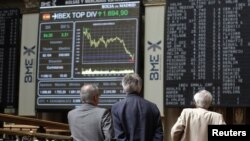
The initial euphoria on world financial markets about Europe's $125 billion bailout of Spanish banks faded quickly Monday as investors reconsidered terms of the rescue package.
Stock indexes in Tokyo and Hong Kong surged more than 2 percent, and markets in London, Frankfurt and Paris moved up sharply in early trading. By the end of the day, however, European markets ended little changed from Friday's closing prices. Major U.S. stock indexes all were down more than 1 percent.
Spain's key market, led by financial stocks, initially jumped 4 percent, but ended the day down one-half of one percent.
Analysts questioned whether the bank bailout would hurt the Spanish government, since it ultimately is responsible for repaying the loans, and its borrowing costs are increasing. Spain is in the third year of a recession. It has the highest unemployment rate in the 17-nation eurozone and is struggling to regain its economic footing.
Related video report by Henry Ridgwell
Robert Halver of the Baader Bank said the rescue package has just given the eurozone a bit more time to resolve the crisis.
"Spain's problems have not been solved, they have just been moved. The clock for the the eurozone has turned back from five-to-12 to 10-to-12 so we won a little bit of time, but the main problem is still the Spanish economy and its inability to carry out reforms and that is something that needs to be worked on," Halver said.
Some Spanish workers said they see little gain with the bank bailout. One court employee, Felicia Lopez, said the policies of Prime Minister Mariano Rajoy are misguided.
"Rajoy's government is rescuing the banks giving them big amounts of money, and at the same time it is destroying citizens' lives, cutting salaries, cutting benefits, cutting basic rights," Lopez said.
In securing the bank rescue, Spain became the fourth eurozone nation to need a bailout, after Greece, Ireland and Portugal. On Monday, Cyprus, one of the smallest of the currency bloc countries, said it, too, could need assistance, possibly within days.
Greece is set for new parliamentary elections Sunday, after last month's vote proved inconclusive. A new government could become the first country to quit the 17-nation euro currency union rather than face austerity measures demanded by the International Monetary Fund and Greece's creditors across Europe.
Some information for this report was provided by AFP and Reuters.
Stock indexes in Tokyo and Hong Kong surged more than 2 percent, and markets in London, Frankfurt and Paris moved up sharply in early trading. By the end of the day, however, European markets ended little changed from Friday's closing prices. Major U.S. stock indexes all were down more than 1 percent.
Spain's key market, led by financial stocks, initially jumped 4 percent, but ended the day down one-half of one percent.
Analysts questioned whether the bank bailout would hurt the Spanish government, since it ultimately is responsible for repaying the loans, and its borrowing costs are increasing. Spain is in the third year of a recession. It has the highest unemployment rate in the 17-nation eurozone and is struggling to regain its economic footing.
Related video report by Henry Ridgwell
Robert Halver of the Baader Bank said the rescue package has just given the eurozone a bit more time to resolve the crisis.
"Spain's problems have not been solved, they have just been moved. The clock for the the eurozone has turned back from five-to-12 to 10-to-12 so we won a little bit of time, but the main problem is still the Spanish economy and its inability to carry out reforms and that is something that needs to be worked on," Halver said.
Some Spanish workers said they see little gain with the bank bailout. One court employee, Felicia Lopez, said the policies of Prime Minister Mariano Rajoy are misguided.
"Rajoy's government is rescuing the banks giving them big amounts of money, and at the same time it is destroying citizens' lives, cutting salaries, cutting benefits, cutting basic rights," Lopez said.
In securing the bank rescue, Spain became the fourth eurozone nation to need a bailout, after Greece, Ireland and Portugal. On Monday, Cyprus, one of the smallest of the currency bloc countries, said it, too, could need assistance, possibly within days.
Greece is set for new parliamentary elections Sunday, after last month's vote proved inconclusive. A new government could become the first country to quit the 17-nation euro currency union rather than face austerity measures demanded by the International Monetary Fund and Greece's creditors across Europe.
Some information for this report was provided by AFP and Reuters.