



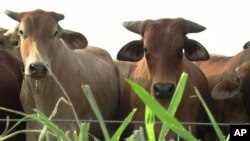
Recent studies at an international agricultural research institute in Colombia have shown that a grass used to feed livestock, known as Brachiaria, could help reduce greenhouse gas emissions from livestock and agriculture and reduce the use of commercial fertilizers. In the United States, for example, agriculture and livestock account for six percent of greenhouse gas emissions.
Cattle and agriculture are blamed as major contributors to greenhouse gas emissions. But chances are, these animals are much less guilty.
They have been fed a grass known as Brachiaria as well as experimental hybrids that could dramatically cut agriculture's contribution to global warming.
Raimundo Cruz works in the cattle industry. He recommends Brachiaria grasses for livestock.
"These cattle get fat very easy and offer better gains because this grass has more protein and is easier to digest," said Cruz.
Cows fed on Brachiaria excrete much less methane, a greenhouse gas. And Cruz says by rotating pineapple and brachiaria grasses every 6 to 8 years, he has tripled the number of cows per hectare and eliminated the use of commercial fertilizers.
"This soil is usually very poor, it could only grow low grass," added Cruz. "But by rotating pineapple and Brachiaria grasses, we have increased its fertility so much that it allows us to have these grasses only seen in fertile lands."
Brachiaria is a grass for grazing widely planted in the tropics. Recently, scientists in Colombia, with Japanese partners, discovered that besides being easy to digest and highly nutritious for cattle, brachiaria improves soil quality, and significantly reduces greenhouse gasses emitted by cattle and commercial fertilizers.
"This is the florescence and each one of these is a seed," noted Idupulapati Rao who is studying Brachiaria at the International Center for Tropical Agriculture (CIAT) in Cali, the third largest city in Colombia. "These grasses with great root systems exude a particular chemical compound, organic compound, that is called brachialactone…"
And that chemical, he explains, triggers a process that inhibits the transformation of nitrogen in the soil into a powerful greenhouse gas. Most commercial fertilizers used in agriculture worldwide use nitrogen as the main nutrient.
"Right now nitrogen fertilizer is like 115 million tons per year around the world," added Rao.
Nitrogen fertilizers emit nitrous oxide, a greenhouse gas 300 times more potent than CO2, the most common greenhouse gas emitted by cars and industry.
Rao says CIAT is researching the genetic map of brachiaria.
"If we know what genes are involved in the production of this chemical and the release of this chemical into the soil, then we can put these genes into major field crops like maize, wheat and rice," explained Rao.
At CIAT, scientists believe Brachiaria and its genes could have other benefits. Here, the white bags contain seeds of different varieties of Brachiaria. Scientists are studying their attributes including resistance to drought, floods and major pests as well as ability to tolerate acid soil.
In other fields, like this one, a hybrid Brachiaria is planted between rows of legumes.
Luis Horacio Franco is an agronomist at CIAT.
"The soil is like a bank," noted Luis Horacio Franco. "If you just withdraw and withdraw all the nutrients, the soil goes bankrupt."
While scientists continue to study Brachiaria's genome, they hope to spread the use of Brachiaria grasses to tropical regions in Africa and Asia.