
News / Science & Technology

Species Loss Compromises Earth’s Vital Systems

Water quality improves in a more diverse ecosystem

Bradley Cardinale built 50 mock streams in his laboratory for the three-year experiment.

Multimedia

Audio
TEXT SIZE - +
Rosanne Skirble

Scientists have long thought that diverse ecosystems like forests, lakes and streams are especially good at removing pollutants that human activities put into the environment.

A new study in the journal Nature, confirms that theory.  

University of Michigan ecologist Bradley Cardinale demonstrates how water quality improves in a more diverse ecosystem.

In his laboratory Cardinale built 150 meter-long cases that enclosed mock streams. He cultured between one and eight common algae species in each waterway. The tiny micro-organisms are important actors in removing pollution from the water. He then exposed the streams to nitrate, a common pollutant from agricultural run-off and auto emissions.
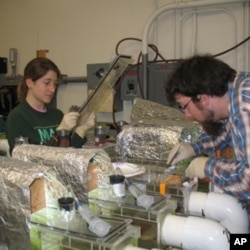
University of Michigan graduate students monitor a water quality experiment.

It took Cardinale three years to set up the experiment, run it and process the data. On average streams with eight species were cleaned four-and-one-half times faster than water with just one species. Cardinale says specific algae species adapt to specific stream habitat.

"As you added more and more species to the stream what happened is that all of these different habitats got filled up and the stream as a whole became a much better bio-filter for this particular nutrient pollutant."

Cardinale says scientists as far back as Charles Darwin in the 1860s proposed that every species plays a specific role in the ecosystem and compliments each other.

"Basically a diverse world always comes down to having unique niches that allow species somehow to exist with each other. So any system where niche partitioning is a key biological phenomenon, the results of the study I’ve shown here and it’s implication for water quality should probably apply."
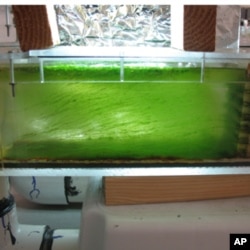
This sample mock stream contains algae growth after six months and represents between 12 to 15 generations and millions of algae cells.

While Cardinale’s study showed that water quality improved in the streams with greater biodiversity, the ecologist notes it did not address how many species would be needed to completely remove the pollutant from soil and water.

"We previously expected that somewhere between three and five species was enough to clean nitrate out of soil and water. And my study extends those results to at least to eight species where we didn’t even begin to see a plateau."

Cardinale says he expects the number is more than eight, but far less than the several hundred found in a stream. The University of Michigan ecologist hopes future studies will determine that tipping point.

You May Like

Experts Weigh In on Challenges of Closing Guantanamo Prison

Former chief military prosecutor at Guantanamo delivers petition to White House with more than 370,000 signatures, demanding facility be closed down immediately More

Karzai to Discuss Enhancing Defense Ties with India

Afghanistan looking for more military aid as it prepares for withdrawal of NATO forces by next year More

India, China Pledge to Overcome Border Tensions

Indian prime minister and Chinese premier attempt to move past tense standoff in the Himalayas during Delhi talks More

Burmese President Opens US Visit with VOA Town Hall Meeting

Ahead of his meeting with President Obama Monday, Thein Sein answered questions on human rights and economic development in his country More

This forum has been closed.
Comments
     
There are no comments in this forum. Be first and add one

Featured Videos

Your JavaScript is turned off or you have an old version of Adobe's Flash Player. Get the latest Flash player.
Video

Video US Oil Surge Could Impact Mideast Geopolitics

The United States will account for a third of new oil supplies over the next five years, and will become energy self-sufficient in 20 years, according to a new report by the Paris-based International Energy Agency (IEA). Although U.S. oil imports from Arab Gulf countries increased last year, analysts predict the U.S. will lose its dependence on Middle East imports, which is expected to have a huge impact on international relations and the balance of power. VOA's Henry Ridgewell reports.