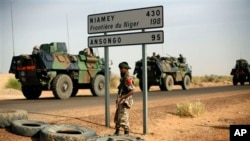
French-backed Malian forces are facing pockets of resistance in northern Mali, after retaking control of the region last month.
VOA's French to Africa Service reports a contingent of troops from France, Mali and Niger on Thursday forced a small group of Islamist militants from Djebock, a town 45 kilometers northeast of Gao. Residents said they were being "terrorized" by the militants.
In another development, four Malian soldiers were killed after their vehicle hit a landmine. The blast occurred Wednesday on a road between Gao and Douentza.
As France begins to wind down its Mali intervention, the United Nations is considering plans to assume control of an international peacekeeping force in the country. However, officials say any action will have to wait until the security situation there stabilizes.
France's U.N. Ambassador Gerard Araud said Wednesday that his country's troops will not be staying in Mali. He described a potential peacekeeping force made up largely of the African troops already in the country.
"There is the prospect of a peacekeeping operation," said Araud. "It was the first time that I was raising the issue in the Security Council and I was insisting on the fact that the deployment will be possible only when the security circumstances permit. So I think we have to wait several weeks before assessing the security environment and taking the decision of deploying a peacekeeping operation.”
French forces entered Mali last month to drive back al-Qaida-linked Islamist militants who controlled the north and were moving in the direction of the capital, Bamako.
U.N. peacekeeping chief Herve Ladsous said Wednesday that troops from the African-led International Support Mission for Mali (AFISMA) are starting to move into what he called the "operational areas" in the north.
Separately, the top U.S. diplomat for Africa, Assistant Secretary of State for African Affairs Johnnie Carson, says any longterm solution for Mali must include recognition of the country's moderate elements.
He told reporters on Thursday that a military solution without a political solution would be an "imperfect solution."
"We must also see negotiations with the moderate Tuaregs, those who renounce violence," said Carson. "The Tuareg, many of them have longstanding political grievances, legitimate and longstanding. They must be dealt with but we also must keep focus on the elimination of AQIM as a threat not only to Mali but also the region."
The Mali crisis began in early 2012 when Tuareg separatist group MNLA launched a rebellion in the north. The MNLA and Islamist militants seized control of the north in April but the MNLA was soon swept aside as the militants imposed harsh Islamic law on the region.
Mali's interim president, Dioncounda Traore, has said his government is willing to negotiate with the MNLA but not the militants.
Diplomats have said privately that a U.N. Security Council resolution authorizing a peacekeeping operation for Mali is not likely before the end of February. It could take another two months after that to transition the African forces into U.N. peacekeepers.
VOA's French to Africa Service reports a contingent of troops from France, Mali and Niger on Thursday forced a small group of Islamist militants from Djebock, a town 45 kilometers northeast of Gao. Residents said they were being "terrorized" by the militants.
In another development, four Malian soldiers were killed after their vehicle hit a landmine. The blast occurred Wednesday on a road between Gao and Douentza.
As France begins to wind down its Mali intervention, the United Nations is considering plans to assume control of an international peacekeeping force in the country. However, officials say any action will have to wait until the security situation there stabilizes.
France's U.N. Ambassador Gerard Araud said Wednesday that his country's troops will not be staying in Mali. He described a potential peacekeeping force made up largely of the African troops already in the country.
"There is the prospect of a peacekeeping operation," said Araud. "It was the first time that I was raising the issue in the Security Council and I was insisting on the fact that the deployment will be possible only when the security circumstances permit. So I think we have to wait several weeks before assessing the security environment and taking the decision of deploying a peacekeeping operation.”
French forces entered Mali last month to drive back al-Qaida-linked Islamist militants who controlled the north and were moving in the direction of the capital, Bamako.
U.N. peacekeeping chief Herve Ladsous said Wednesday that troops from the African-led International Support Mission for Mali (AFISMA) are starting to move into what he called the "operational areas" in the north.
Separately, the top U.S. diplomat for Africa, Assistant Secretary of State for African Affairs Johnnie Carson, says any longterm solution for Mali must include recognition of the country's moderate elements.
He told reporters on Thursday that a military solution without a political solution would be an "imperfect solution."
"We must also see negotiations with the moderate Tuaregs, those who renounce violence," said Carson. "The Tuareg, many of them have longstanding political grievances, legitimate and longstanding. They must be dealt with but we also must keep focus on the elimination of AQIM as a threat not only to Mali but also the region."
The Mali crisis began in early 2012 when Tuareg separatist group MNLA launched a rebellion in the north. The MNLA and Islamist militants seized control of the north in April but the MNLA was soon swept aside as the militants imposed harsh Islamic law on the region.
Mali's interim president, Dioncounda Traore, has said his government is willing to negotiate with the MNLA but not the militants.
Diplomats have said privately that a U.N. Security Council resolution authorizing a peacekeeping operation for Mali is not likely before the end of February. It could take another two months after that to transition the African forces into U.N. peacekeepers.