


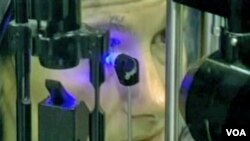
Millions of diabetics around the world are threatened with vision loss, a secondary effect of their disease, but researchers are exploring whether stem cells can be used to treat or prevent this diabetic complication.
Juvenile and adult-onset diabetes result when the body's ability to regulate blood sugar levels goes awry. When the condition becomes chronic, it can lead to cardiovascular disease, damage the kidneys and affect blood flow to the limbs, sometimes requiring amputations.
The disease also affects the eyes, according to Alan Stitt of Queen’s University in Belfast, Ireland. Chronically high blood sugar levels can cause a condition called diabetic retinopathy, in which the tiny blood vessels that nourish the retina, the light sensitive tissue at the back of the eye, become blocked or leak.
“They then can actually no longer carry the oxygen and the nutrients that the retina requires," Stitt says. "And the retina becomes increasingly dysfunctional as a result of these blood vessels not functioning properly.”
If left untreated, diabetic retinopathy can lead to partial or total blindness.
Stitt, who directs the Queen's University Center for Vision and Vascular Science, is participating in a European-led study called Repair of Diabetic Damage by Stromal Cell Administration (REDDSTAR).
Researchers from the U.S., Northern Ireland, Germany, the Netherlands, Denmark and Portugal are also taking part. Each team is trying to prevent and minimize damage to a particular organ as a result of diabetes.
The scientists are using adult stem cells isolated from bone marrow, the spongy tissue inside bones. Stem cells are master cells that can be coaxed to morph into any type of tissue cell in the body.
In Stitt’s laboratory, the stem cells are being injected directly into the eyes of mice bred to have diabetic retinopathy. So far, he says, the results are encouraging, showing signs that the progression toward blindness can be halted as the tiny retinal blood vessels are repaired and regenerated by the stem cells:
“They are very clever cells, because what we know from the evidence we’ve got is that they seem to have this ability to go to where the tissue needs them to go," Stitt says. "So they recognize where there’s not enough blood vessels and they can actually then participate in the blood vessel regrowth.”
Current treatments for diabetic retinopathy, including laser surgery to stop retinal leakage, are directed toward patients with advanced disease. Such medical interventions are painful, costly and frequently unsuccessful.
Stitt expects to begin human trials with the potentially eyesight-saving stem cell therapy in about two years.
Juvenile and adult-onset diabetes result when the body's ability to regulate blood sugar levels goes awry. When the condition becomes chronic, it can lead to cardiovascular disease, damage the kidneys and affect blood flow to the limbs, sometimes requiring amputations.
The disease also affects the eyes, according to Alan Stitt of Queen’s University in Belfast, Ireland. Chronically high blood sugar levels can cause a condition called diabetic retinopathy, in which the tiny blood vessels that nourish the retina, the light sensitive tissue at the back of the eye, become blocked or leak.
“They then can actually no longer carry the oxygen and the nutrients that the retina requires," Stitt says. "And the retina becomes increasingly dysfunctional as a result of these blood vessels not functioning properly.”
If left untreated, diabetic retinopathy can lead to partial or total blindness.
Stitt, who directs the Queen's University Center for Vision and Vascular Science, is participating in a European-led study called Repair of Diabetic Damage by Stromal Cell Administration (REDDSTAR).
Researchers from the U.S., Northern Ireland, Germany, the Netherlands, Denmark and Portugal are also taking part. Each team is trying to prevent and minimize damage to a particular organ as a result of diabetes.
The scientists are using adult stem cells isolated from bone marrow, the spongy tissue inside bones. Stem cells are master cells that can be coaxed to morph into any type of tissue cell in the body.
In Stitt’s laboratory, the stem cells are being injected directly into the eyes of mice bred to have diabetic retinopathy. So far, he says, the results are encouraging, showing signs that the progression toward blindness can be halted as the tiny retinal blood vessels are repaired and regenerated by the stem cells:
“They are very clever cells, because what we know from the evidence we’ve got is that they seem to have this ability to go to where the tissue needs them to go," Stitt says. "So they recognize where there’s not enough blood vessels and they can actually then participate in the blood vessel regrowth.”
Current treatments for diabetic retinopathy, including laser surgery to stop retinal leakage, are directed toward patients with advanced disease. Such medical interventions are painful, costly and frequently unsuccessful.
Stitt expects to begin human trials with the potentially eyesight-saving stem cell therapy in about two years.