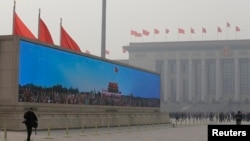
In the face of growing protests and public frustration about China's smoggy air and polluted rivers, leaders at the National People's Congress this week are holding meetings to discuss how to clean up the environment.
The government is looking at revisions to a law that regulates air quality, which has already been languishing as a draft for two years in China’s legislature.
The meetings come as suffocating stints of bad air have blanketed large parts of the country in recent weeks and prompted public outcry over the situation.
Environmentalists say that while the government has made some efforts it is still not enough to keep up with the impact of the country's rapid economic expansion on the environment.
Public calls for action
Zhou Rong, climate and energy campaigner at Greenpeace, says it's unlikely any major changes will be made at the National People's Congress.
A spokeswoman from the National People's Congress was quoted by Chinese media as saying that China's top legislature will “respond positively to public concerns” about environmental issues and revise and improve the Law on the Prevention and Treatment of Air Pollution. The reports did not provide details on the timing of the revision.
Zhou says that the delay in scheduling higher-level deliberation of the amendments is disappointing many in China.
“Considering the challenges we are facing, we must make some changes now, not wait another year,” Zhou said.
Since the beginning of the year, residents in Beijing and other northern cities have had to endure weeks of toxic air, heavy with so-called PM 2.5, which are particles small enough to penetrate and nest in people's lungs.
A study conducted last December by Greenpeace East Asia and Peking University's School of Public Health found that high levels of PM 2.5 pollutants were responsible for over 8,500 premature deaths in four major Chinese cities. The study also estimates that economic losses from pollution in the cities of Shanghai, Beijing, Guangzhou, and Xi'an amount to more than a billion U.S. dollars last year alone.
Environment, health under threat
The government has taken precautions such as requiring local officials to issue alerts when pollution reaches hazardous levels, but some residents are calling for a more systematic approach.
Environmental groups in Beijing drafted an online petition to the capital city's government, asking for masks and other protective gear be given to all Beijing dwellers.
“Because we understand that fixing the problem of air pollution is a long and arduous process,” the petition reads, “we advise the government to carry out a “emergency response pilot on heavily polluted days.”
Beijing authorities proposed their own bill in early February that includes provisions on pollution prevention and standards on energy use within the city limits.
Environmental organizations say that by making the draft open to public comments, Beijing has shown some commitment to being transparent and accountable.
Pollution not cost-free
The Natural Resources Defense Council, an international non-profit environmental group, has suggested improving the draft by strengthening enforcement of the existing laws, as well as increasing penalties for pollution violations. Currently in China, the maximum fine for surpassing emission standards is less than $16,000.
Duan Lei, professor at the Tsinghua University school of Environment, says there are positive signs at the national level, such as subsidies to make coal production cleaner.
“Generally speaking they have taken a few measures, but obviously they are not enough, and that is because China's pace of development is too rapid,” he said.
China's outgoing premier, Wen Jiabao, this week acknowledged that economic development was coming to conflict with environmental protection.
Greenpeace's Zhou Rong says that a shift of priorities needs to happen within the government. Instead of only relying on GDP growth and economic indexes to judge the success of the country, says Zhou, Chinese politicians should think harder about the environmental impact of their policies.
The government is looking at revisions to a law that regulates air quality, which has already been languishing as a draft for two years in China’s legislature.
The meetings come as suffocating stints of bad air have blanketed large parts of the country in recent weeks and prompted public outcry over the situation.
Environmentalists say that while the government has made some efforts it is still not enough to keep up with the impact of the country's rapid economic expansion on the environment.
Public calls for action
Zhou Rong, climate and energy campaigner at Greenpeace, says it's unlikely any major changes will be made at the National People's Congress.
A spokeswoman from the National People's Congress was quoted by Chinese media as saying that China's top legislature will “respond positively to public concerns” about environmental issues and revise and improve the Law on the Prevention and Treatment of Air Pollution. The reports did not provide details on the timing of the revision.
Zhou says that the delay in scheduling higher-level deliberation of the amendments is disappointing many in China.
“Considering the challenges we are facing, we must make some changes now, not wait another year,” Zhou said.
Since the beginning of the year, residents in Beijing and other northern cities have had to endure weeks of toxic air, heavy with so-called PM 2.5, which are particles small enough to penetrate and nest in people's lungs.
A study conducted last December by Greenpeace East Asia and Peking University's School of Public Health found that high levels of PM 2.5 pollutants were responsible for over 8,500 premature deaths in four major Chinese cities. The study also estimates that economic losses from pollution in the cities of Shanghai, Beijing, Guangzhou, and Xi'an amount to more than a billion U.S. dollars last year alone.
Environment, health under threat
The government has taken precautions such as requiring local officials to issue alerts when pollution reaches hazardous levels, but some residents are calling for a more systematic approach.
Environmental groups in Beijing drafted an online petition to the capital city's government, asking for masks and other protective gear be given to all Beijing dwellers.
“Because we understand that fixing the problem of air pollution is a long and arduous process,” the petition reads, “we advise the government to carry out a “emergency response pilot on heavily polluted days.”
Beijing authorities proposed their own bill in early February that includes provisions on pollution prevention and standards on energy use within the city limits.
Environmental organizations say that by making the draft open to public comments, Beijing has shown some commitment to being transparent and accountable.
Pollution not cost-free
The Natural Resources Defense Council, an international non-profit environmental group, has suggested improving the draft by strengthening enforcement of the existing laws, as well as increasing penalties for pollution violations. Currently in China, the maximum fine for surpassing emission standards is less than $16,000.
Duan Lei, professor at the Tsinghua University school of Environment, says there are positive signs at the national level, such as subsidies to make coal production cleaner.
“Generally speaking they have taken a few measures, but obviously they are not enough, and that is because China's pace of development is too rapid,” he said.
China's outgoing premier, Wen Jiabao, this week acknowledged that economic development was coming to conflict with environmental protection.
Greenpeace's Zhou Rong says that a shift of priorities needs to happen within the government. Instead of only relying on GDP growth and economic indexes to judge the success of the country, says Zhou, Chinese politicians should think harder about the environmental impact of their policies.