




The garments we’ll wear in the future will be different than our clothes today. Not just different colors, styles or fabrics. Future fashion will be smart. Our clothes may be able to reduce our stress levels or change color based on our mood.
Several examples of advanced textile technology were showcased by students at MICA - the Maryland Institute College of Arts - recently.
“I think a lot of bridal gowns are just really redundant and I think they need to be more exciting than they already are. They have just become so traditional,” says Matthew Reading, a student in the Wash and Wear Electronics course at Maryland Institute College of Arts or MICA.
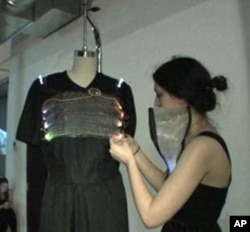
Reading sewed washable microcontrollers, called Lilypad Arduinos, onto the bridal gown he designed.
“The red thing, you can use it to program light and motors and different sensors that react to motion and light and temperature. The blue things, those are servo motors.They are tiny motors that can be programmed with a Lilypad and they move back and forth or around. And you can do different kind of kinetic applications with it.”
Reading’s classmate Veronika Olsen focused on more functional applications. She designed a jacket that she says monitors the wearer’s stress level. A skin response sensor attached to the sleeve measures the conductivity of the sweat glands.
“I have programmed it in its microprocessor that when your body reaches a certain level of stress, it turns on an audio player that plays then through the headphones," says Olsen. "And it plays binaural beats, which are used to calm you down.”
Artist Annet Couwenberg is a professor in MICA’s fiber department. She developed the Smart Textiles Research Lab two years ago to combine traditional craftsmanship with 21st century technology.
“I think it is the future. We all know that technology and gadgets are getting smaller, that become more flexible, that they are really now being integrated into the tech cells," says Couwenberg. "And that will have a tremendous influence on how we are going to see, where art and technology and fashion are going to meet.”
Tabor Barranti’s idea of future innovative fashion incorporates fabric that can change color. “It really is dynamic so if you decide, 'Oh hey, I want to wear a red dress today,' you can change it from a green dress to a red dress just based on the programming with the microprocessor.”
Sasha de Koninck is exploring fibers and sound. She wants to use fabric that can conduct electricity to create a 'performance garment' that makes music. "You play the conductive thread with the spoon and the pressure that you place on the fabric with the spoon changes these numbers which controls the volume."
Nolla Yuan made an LED studded leather jacket. It's more of a fun garment, she says, that she could wear to a party.
Everything showcased by the students is a prototype. But their professor, Annet Couwenberg, says smart textiles have a wide range of practical applications and the potential to revolutionize the fashion industry.