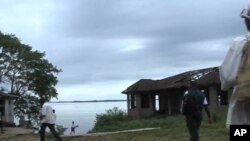



Some former slave ports in Africa are now tourist destinations, but not Bunce Island in Sierra Leone. It's abandoned and its slave castle is in ruins.
The British established Bunce Island as a slave port in the 1670s.
From here, thousands of West Africans were sent in chains to rice fields in the American south.
Planters from colonies in South Carolina and Georgia were willing to pay extra for the expertise of the rice growers, captured on West Africa's rice coast, stretching from what is now Senegal to Liberia.
Journalists, students, staff and teachers from the Fatima Institute, in Makeni, Sierra Leone, recently decided it was time for them to look into this history themselves.
They traveled in a cramped four by four on a route that included driving on railroad tracks, and then getting on a pirogue (boat).
They broadcast their journey into history live on their radio station back in Makeni, via cell phone.
One teacher, Boniface Sidiki Kamara, expressed concern at how difficult it was to get to the island. He compared it unfavorably to a trip he made to tourist sites in Europe. "I remember when I went to Italy, I saw the grave, the tomb of Saint Francis of Assisi. You could see thousands of people lining up just to go pay and see this place," he said.
The live commentary of their trip continued from the leaky pirogue, with one student David Ngobeh being handed the phone. "Oh, Charles, this is quite impressive," he said.
After several hours, the group finally arrived, tired but reenergized. For most, it was their first time on an island they had read about in textbooks and even dreamed about as a link to the rest of the world.
They said the slave history tying Sierra Leone to Europe and the United States was not shameful, but instead a source of pride.
They all expressed disappointment that their own government was not doing more to conserve the island.
"It tells you about man's inhumanity to man, I mean, the cruelty of man, the evil side of our own nature as human beings. But also it tells you about the resilience of the human spirit, that I mean people survived after being shipped from this place. Because of slavery, because of this experience, so many people came out and they have done good to our world," said Reverend Joe Turay from the Fatima Institute.
Turay said turning the island into a tourist spot also could help Sierra Leone overcome its own painful past, following years of civil war. "This takes us to the new discourse of human rights. There are various forms of injustices happening in our situation, in our country, in our context today. The slave island should serve as a symbol, as a symbol of resistance, a symbol of the fight against injustices," he said.
At the end of the visit, the group broke out in impromptu singing, feeling very much connected to world history and hoping others could also feel some of their emotions for this abandoned, but not forgotten, place.
Students Try to Save Slave Island in Sierra Leone