



Radiation from Japan's damaged Fukushima nuclear plant is affecting life nearby.
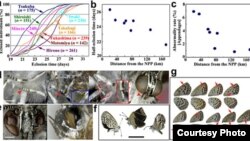
Scientists collected butterflies at seven sites near the plant, and found that 12.4 percent had physical defects, including misshapen or undeveloped forelegs, dented eyes and tattered-looking wings. This abnormality rate rose to 18.3 percent in the next generation, even when scientists bred the butterflies with normal mates in their lab, proving that genetic damage was inheritable.
Six months after the accident, scientists found that rates of abnormalities in the wild had more than doubled. The team says this increase may be due to continuous low-dose exposure over generations. The team's results appeared in Science Reports, an online publication associated with the journal Nature.
The scientists call for further research into the possible risks that eating radiation-contaminated plants poses to animals. Yet, one of the researchers, Joji Otaki of the University of Ryukyus in Okinawa, told the Japan Times that people need not worry about similar mutations occurring. "Humans are totally different from butterflies and they should be far more resistant" to radiation.
Scientists collected butterflies at seven sites near the plant, and found that 12.4 percent had physical defects, including misshapen or undeveloped forelegs, dented eyes and tattered-looking wings. This abnormality rate rose to 18.3 percent in the next generation, even when scientists bred the butterflies with normal mates in their lab, proving that genetic damage was inheritable.
Six months after the accident, scientists found that rates of abnormalities in the wild had more than doubled. The team says this increase may be due to continuous low-dose exposure over generations. The team's results appeared in Science Reports, an online publication associated with the journal Nature.
The scientists call for further research into the possible risks that eating radiation-contaminated plants poses to animals. Yet, one of the researchers, Joji Otaki of the University of Ryukyus in Okinawa, told the Japan Times that people need not worry about similar mutations occurring. "Humans are totally different from butterflies and they should be far more resistant" to radiation.