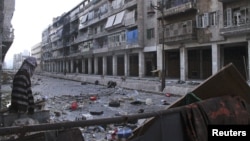
Drought, urban decline and government collapse ended Syria's central economic role in the Middle East 4200 years ago. Research from the University of Sheffield in England points to striking parallels between today's war-torn Syria and political upheavals in the Bronze-Age Mesopotamian empire known as Akkadia.
Ellery Frahm, of the university's Department of Archeology, found the connection by studying the trade in obsidian in the cosmopolitan commercial center of Urkesh, in what is now northeastern Syria.
The volcanic glass, used to make razor-sharp cutting tools, came from six different volcanoes before the fall of the Akkadian Empire, which stretched through modern-day Iraq.
As trade routes and regional governments collapsed, during what some historians say was a period of rising militarism and violence, the city was able to get obsidian from only two nearby sources, showing the impact of the crisis on the movement of people and goods.
In addition, Frahm says, farming in the area then, as now, relied principally on rainfall rather than irrigation, and Akkadian harvests could not keep up with the region's increasing population. He adds that with today's climate shifts causing increasing drought and with ever larger populations to feed, modern Syrian agriculture, too, is unsustainable.
Frahm stresses that his work is not making light of the current violence in Syria. Instead, he says, it is offering a way to understand what could lie ahead, by revealing how the country's ancient precursors reacted to their own internal and external crises.
Ellery Frahm, of the university's Department of Archeology, found the connection by studying the trade in obsidian in the cosmopolitan commercial center of Urkesh, in what is now northeastern Syria.
The volcanic glass, used to make razor-sharp cutting tools, came from six different volcanoes before the fall of the Akkadian Empire, which stretched through modern-day Iraq.
As trade routes and regional governments collapsed, during what some historians say was a period of rising militarism and violence, the city was able to get obsidian from only two nearby sources, showing the impact of the crisis on the movement of people and goods.
In addition, Frahm says, farming in the area then, as now, relied principally on rainfall rather than irrigation, and Akkadian harvests could not keep up with the region's increasing population. He adds that with today's climate shifts causing increasing drought and with ever larger populations to feed, modern Syrian agriculture, too, is unsustainable.
Frahm stresses that his work is not making light of the current violence in Syria. Instead, he says, it is offering a way to understand what could lie ahead, by revealing how the country's ancient precursors reacted to their own internal and external crises.