


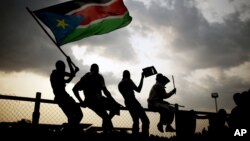
South Sudan, the world's newest country, marked the first anniversary of its independence from Sudan Monday amid troubled relations with Khartoum.
Members of the Sudanese and South Sudanese Diaspora in the United States held a "We Choose Peace" rally in front of the White House to commemorate the one year anniversary.
Niemat Ahmadi, director of Global Partnerships at United to End Genocide and a rally participant, said part of their message was to call on the international community to fulfill its commitment to bring peace between the two countries.
“We were so happy that our brothers and sisters from that corner of Sudan were able to exercise their rights. Unfortunately, until today, the violence continues to destabilize both Sudans. That is why we came here today, July 8, to recognize the independence of the south. But, also to raise our voices and denounce the violence,” she said.
Participants at the rally, which was endorsed by Amnesty International USA, civil society organizations and faith leaders from around the world demanded protection for civilians, unhindered humanitarian access, and justice and accountability.
Ahmadi said the Sudanese and South Sudanese diaspora communities will continue to advocate for peace between the Sudans.
“[We have come] together to work for peace and also [to call] for the international community, particularly the United States as the leading government within the international community, to lead the world to open, or provide, humanitarian assistance to all those who are suffering,” Ahmadi said.
The group said any peace arrangement between the two Sudans must adhere to the African Union’s Roadmap for Peace and comply in full with U.N. Resolution 2046, agreed on May 2, which called for an immediate end to hostilities, withdrawal of forces and a resumption of negotiations at the AU.
Ahmadi admits that bringing peace in Sudan would not be an easy task. But, she said, with the help of the international community, peace can be achieved.
“Bringing peace in a country where the government is killing its own people is not an easy task. And that is why we needed the voice of everybody and wanted the commitment of the US government and from the international community and the UN Security Council that the people of Sudan are not for war. They are for peace,” Ahmadi said.
The rally participants also called on the international community to support the International Criminal Court arrest warrants against all suspects, including President Omar al-Bashir.
Ahmadi said rally participants also wanted to call international attention to the suffering of the people in South Kordofan and Darfur.
Since South Sudanese secession, failure to resolve key issues and tensions between the two countries and within Sudan itself has led to an escalation of conflict and the threat of a return to all-out war.
When South Sudan became independent on July 9 of last year, the new country got the majority of the region's oil fields. But Khartoum demands high payments for transfer of the oil from the landlocked South through its territory to the sea ports.
The South Sudan government has shut down the oil production, which is its only source of foreign revenue, and is now lacking the means to improve the livelihood of its citizens.
The shutdown also has led to an economic collapse with food and fuel prices inflating out of proportion in the country that depends on imports.
A shortage of schools, health facilities, roads and opportunities for young people has fueled a series of conflicts.
In addition to border skirmishes with Sudan, Juba has to deal with rebel and tribal violence, while it is also struggling to build basic institutions.
Members of the Sudanese and South Sudanese Diaspora in the United States held a "We Choose Peace" rally in front of the White House to commemorate the one year anniversary.
Niemat Ahmadi, director of Global Partnerships at United to End Genocide and a rally participant, said part of their message was to call on the international community to fulfill its commitment to bring peace between the two countries.
“We were so happy that our brothers and sisters from that corner of Sudan were able to exercise their rights. Unfortunately, until today, the violence continues to destabilize both Sudans. That is why we came here today, July 8, to recognize the independence of the south. But, also to raise our voices and denounce the violence,” she said.
Participants at the rally, which was endorsed by Amnesty International USA, civil society organizations and faith leaders from around the world demanded protection for civilians, unhindered humanitarian access, and justice and accountability.
Ahmadi said the Sudanese and South Sudanese diaspora communities will continue to advocate for peace between the Sudans.
“[We have come] together to work for peace and also [to call] for the international community, particularly the United States as the leading government within the international community, to lead the world to open, or provide, humanitarian assistance to all those who are suffering,” Ahmadi said.
The group said any peace arrangement between the two Sudans must adhere to the African Union’s Roadmap for Peace and comply in full with U.N. Resolution 2046, agreed on May 2, which called for an immediate end to hostilities, withdrawal of forces and a resumption of negotiations at the AU.
Ahmadi admits that bringing peace in Sudan would not be an easy task. But, she said, with the help of the international community, peace can be achieved.


“Bringing peace in a country where the government is killing its own people is not an easy task. And that is why we needed the voice of everybody and wanted the commitment of the US government and from the international community and the UN Security Council that the people of Sudan are not for war. They are for peace,” Ahmadi said.
The rally participants also called on the international community to support the International Criminal Court arrest warrants against all suspects, including President Omar al-Bashir.
Ahmadi said rally participants also wanted to call international attention to the suffering of the people in South Kordofan and Darfur.
Since South Sudanese secession, failure to resolve key issues and tensions between the two countries and within Sudan itself has led to an escalation of conflict and the threat of a return to all-out war.
When South Sudan became independent on July 9 of last year, the new country got the majority of the region's oil fields. But Khartoum demands high payments for transfer of the oil from the landlocked South through its territory to the sea ports.
The South Sudan government has shut down the oil production, which is its only source of foreign revenue, and is now lacking the means to improve the livelihood of its citizens.
The shutdown also has led to an economic collapse with food and fuel prices inflating out of proportion in the country that depends on imports.
A shortage of schools, health facilities, roads and opportunities for young people has fueled a series of conflicts.
In addition to border skirmishes with Sudan, Juba has to deal with rebel and tribal violence, while it is also struggling to build basic institutions.