


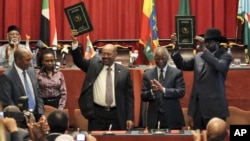
Sudan and South Sudan signed agreements Thursday to demilitarize their border and resume the transport of southern oil through the north. The signed agreements do not deal with the oil-producing Abyei region and several other disputed border regions.
President Omar al-Bashir of Sudan and President Salva Kiir of South Sudan reached the agreements after four days of intense talks between their negotiating teams.
Establishing a demilitarized zone along the border has been a major point of disagreement for the neighboring countries. Both countries have now promised to pull their soldiers back 10 kilometers from the border.
An economic settlement deals with issues such as pensions, banking, national debt, and trade matters.
The countries also reached agreement on the status of each country's nationals on the other's territory.
The deals mean that oil production can resume, as the sides have agreed on transit fees the south will pay to use northern pipelines. South Sudan shut down its oil production in January after disputes over fees, affecting the economy of both countries severely.
The issue of Abyei and the borders remain unresolved. President Salva Kiir of South Sudan blames Sudan for not reaching an agreement:
“As for Abyei, it is very unfortunate that we could not agree. My government and I accepted unconditionally the proposal of the AU-HIP, to the resolution of the conflict in Abyei," he said. "Unfortunately, my brother Bashir and his government totally rejected the proposal in its totality. It is not the responsibility of the AU-HIP to refer the matter to the AU Peace and Security Council.”
Watch related video
African Union mediator Thabo Mbeki, the chairman of the African Union High-Level Implementation Panel, said he is confident that the two countries will solve the outstanding issues easily:
“The parties have agreed on a process to continue to engage with each other on the matter of the disputed and claimed border areas," said Mbeki. "They will engage, they will continue to negotiate this matter and it shouldn’t be difficult to solve this particular matter.”
The presidents of Sudan and South Sudan arrived in Addis Ababa on Sunday, a day after a United Nations Security Council deadline for the countries to settle their issues. Delegations of the two countries have held talks in Ethiopia since the beginning of September.
More talks are needed, but it will take time before the two countries will meet again says Ambassador Bedredin Abdella of the Sudanese delegation:
"There is going to be this team of African experts, they are going to handle this, the five disputed areas issue, and according to the agreement they may take about three months to resolve that situation," said Abdella. "And after that they are going to give a written opinion to the two sides of the facilitators regarding to their opinion, which is non-binding."
South Sudan and Sudan split up in 2011 under a 2005 peace agreement. South Sudan gained about 70 percent of the oil production. Continuing disputes almost led to an all-out war in April of this year.
Sudan Timeline
President Omar al-Bashir of Sudan and President Salva Kiir of South Sudan reached the agreements after four days of intense talks between their negotiating teams.
Establishing a demilitarized zone along the border has been a major point of disagreement for the neighboring countries. Both countries have now promised to pull their soldiers back 10 kilometers from the border.
An economic settlement deals with issues such as pensions, banking, national debt, and trade matters.
The countries also reached agreement on the status of each country's nationals on the other's territory.
The deals mean that oil production can resume, as the sides have agreed on transit fees the south will pay to use northern pipelines. South Sudan shut down its oil production in January after disputes over fees, affecting the economy of both countries severely.
The issue of Abyei and the borders remain unresolved. President Salva Kiir of South Sudan blames Sudan for not reaching an agreement:
“As for Abyei, it is very unfortunate that we could not agree. My government and I accepted unconditionally the proposal of the AU-HIP, to the resolution of the conflict in Abyei," he said. "Unfortunately, my brother Bashir and his government totally rejected the proposal in its totality. It is not the responsibility of the AU-HIP to refer the matter to the AU Peace and Security Council.”
Watch related video
African Union mediator Thabo Mbeki, the chairman of the African Union High-Level Implementation Panel, said he is confident that the two countries will solve the outstanding issues easily:
“The parties have agreed on a process to continue to engage with each other on the matter of the disputed and claimed border areas," said Mbeki. "They will engage, they will continue to negotiate this matter and it shouldn’t be difficult to solve this particular matter.”
The presidents of Sudan and South Sudan arrived in Addis Ababa on Sunday, a day after a United Nations Security Council deadline for the countries to settle their issues. Delegations of the two countries have held talks in Ethiopia since the beginning of September.
More talks are needed, but it will take time before the two countries will meet again says Ambassador Bedredin Abdella of the Sudanese delegation:
"There is going to be this team of African experts, they are going to handle this, the five disputed areas issue, and according to the agreement they may take about three months to resolve that situation," said Abdella. "And after that they are going to give a written opinion to the two sides of the facilitators regarding to their opinion, which is non-binding."
South Sudan and Sudan split up in 2011 under a 2005 peace agreement. South Sudan gained about 70 percent of the oil production. Continuing disputes almost led to an all-out war in April of this year.
Sudan Timeline
Loading timeline...