


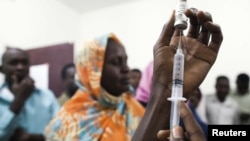
GENEVA — Sudan’s Federal Ministry of Health is organizing an emergency mass vaccination campaign against mosquito-borne yellow fever in the Darfur region. The latest figures from the World Health Organization put the number of suspected cases of yellow fever at 732, including 165 deaths.
This is the worst yellow fever epidemic to strike Africa in two decades. The last outbreak 20 years ago, also was in Sudan. At that time, 604 cases, with 156 deaths were reported in South Kordofan state, the epicenter of the disease. Given the number of cases and deaths reported in Darfur, the World Health Organization notes the current epidemic already has surpassed the last one.
WHO reports the emergency-response vaccination campaign will cover 5.5 million people. It is being conducted in three phases. The first phase of the campaign began November 21 to cover 2.2 million people in 12 districts with the highest number of cases.
Targeting Cities
The second phase of the campaign aims to reach 1.2 million people and is to start next week. Vaccines are due to arrive in Sudan on Sunday and will cover urban areas.
WHO Representative in Sudan, Dr. Anshu Banerjee, said people in urban areas are more vulnerable to getting Yellow Fever than are people in rural areas. He explained this is because the disease is quickly transmitted from mosquitoes to humans in the cities, whereas in the rural areas, monkeys are the reservoir of the virus and the spread is slower.
Banerjee said an additional 2.2 million people will be vaccinated in a third round in all other districts where positive cases are found.
“The challenges mainly are to reach the remote areas, partly because of transportation - no roads, etcetera, and also because of insecurity, because of high risk of hijacking of cars, etcetera," said Banerjee. "So, transport modalities, which are being used now are like using donkeys to transport vaccines, which takes about eight to 10 hours for people to transport vaccines to remote areas.”
Nomads hit hard
Banerjee said most of the cases of Yellow Fever are among nomads, which is why the epidemic is spreading so widely throughout Darfur.
He said Darfur, which was inundated with heavy rains, became a massive breeding ground for mosquitoes during the past year. He said the mosquitoes became infected from the monkeys in the forest and, in turn, have been affecting the human population.
“There are also areas where we have mines and where there are migrant laborers coming from Chad, etcetera. So, one of the important issues also to cover this outbreak in Darfur is to make sure that it doesn’t spread to other countries, like South Sudan and Chad, and also to make sure that it stays well within Darfur, within Sudan, because the vector is available throughout Sudan.”
Yellow Fever is a hemorrhagic disease. There is no cure. Bleeding can be managed by blood transfusions. Otherwise, the disease can be contained through the use of bed nets, insect repellent and the wearing of long clothes. The most effective preventive measure is vaccination.
This is the worst yellow fever epidemic to strike Africa in two decades. The last outbreak 20 years ago, also was in Sudan. At that time, 604 cases, with 156 deaths were reported in South Kordofan state, the epicenter of the disease. Given the number of cases and deaths reported in Darfur, the World Health Organization notes the current epidemic already has surpassed the last one.
WHO reports the emergency-response vaccination campaign will cover 5.5 million people. It is being conducted in three phases. The first phase of the campaign began November 21 to cover 2.2 million people in 12 districts with the highest number of cases.
Targeting Cities
The second phase of the campaign aims to reach 1.2 million people and is to start next week. Vaccines are due to arrive in Sudan on Sunday and will cover urban areas.
WHO Representative in Sudan, Dr. Anshu Banerjee, said people in urban areas are more vulnerable to getting Yellow Fever than are people in rural areas. He explained this is because the disease is quickly transmitted from mosquitoes to humans in the cities, whereas in the rural areas, monkeys are the reservoir of the virus and the spread is slower.
Banerjee said an additional 2.2 million people will be vaccinated in a third round in all other districts where positive cases are found.
“The challenges mainly are to reach the remote areas, partly because of transportation - no roads, etcetera, and also because of insecurity, because of high risk of hijacking of cars, etcetera," said Banerjee. "So, transport modalities, which are being used now are like using donkeys to transport vaccines, which takes about eight to 10 hours for people to transport vaccines to remote areas.”
Nomads hit hard
Banerjee said most of the cases of Yellow Fever are among nomads, which is why the epidemic is spreading so widely throughout Darfur.
He said Darfur, which was inundated with heavy rains, became a massive breeding ground for mosquitoes during the past year. He said the mosquitoes became infected from the monkeys in the forest and, in turn, have been affecting the human population.
“There are also areas where we have mines and where there are migrant laborers coming from Chad, etcetera. So, one of the important issues also to cover this outbreak in Darfur is to make sure that it doesn’t spread to other countries, like South Sudan and Chad, and also to make sure that it stays well within Darfur, within Sudan, because the vector is available throughout Sudan.”
Yellow Fever is a hemorrhagic disease. There is no cure. Bleeding can be managed by blood transfusions. Otherwise, the disease can be contained through the use of bed nets, insect repellent and the wearing of long clothes. The most effective preventive measure is vaccination.