


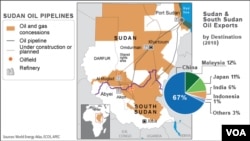
South Sudan said it reached the agreement with Sudan during African-Union mediated talks in Addis Ababa.
The South Sudan government said the deal, reached Saturday, calls for the South to pay an average of $9.48 a barrel to transport oil through northern pipelines.
The agreement, which still has to be finalized, will last three-and-a-half years, during which time South Sudan will also pay Sudan more than $3 billion in compensation for economic losses. South Sudan took over most of Sudan's oil wells when it became independent last year.
The government said “This is a good deal for South Sudan.”
Dana Wilkins, South Sudan and Sudan analyst for Global Witness, which monitors natural resources, said the agreement makes sense for South Sudan.
“At this point, a deal, period, is a good thing," said Wilkins. "And both sides have made compromises here and actually if you compare the current arrangement to what was previously offered by South Sudan, it's not that far off from it.”
And U.S. Secretary of State Hillary Clinton also welcomed Saturday's deal, which was announced hours after she met with South Sudanese President Salva Kiir in Juba.
In Nairobi on Saturday, Clinton made it sound as though South Sudan had needed to be convinced to reach a deal.
“This agreement reflects leadership and a new spirit of compromise on both sides. And I particularly praise the courage of the republic of South Sudan leadership in taking this decision,” Clinton said.
A senior State Department official said Clinton used her “diplomatic influence” to “strongly encourage” Mr. Kiir to accept the deal.
Wilkins at Global Witness said the two sides were never as far apart during the oil negotiations as they made themselves out to be, but that a deal was held up by other outstanding disputes left over from their separation.
The two countries have yet to reach agreement on a system to jointly monitor their border and to determine the final status of disputed areas.
Sudan has been particularly concerned about South Sudan's alleged support of rebel groups north of the border.
Sudan's state-media reported that government negotiators said oil production will not resume until security arrangements are in place.
And even if these disputes are settled, Wilkins said, it will take some time before the oil starts flowing.
"Hopefully the fact that an oil deal has been agreed, the fact that both sides need access to oil revenues, will put pressure on both to agree to the other issues, but there's still going to be delays there, but then there are also technical delays, in terms of how quickly oil production can actually resume," she said.
Wilkins also said the success of the deal will depend on the details, and noted there is no indication whether there will be an independent verification mechanism to make sure both sides are being honest in their dealings and pumping or importing as much oil as they claim.
South Sudan has also emphasized that this deal is only good for the next three-and-a-half years.
Juba hopes to complete another oil pipeline to the Kenyan coast in that time, cutting Sudan out of the equation as much as possible.