



Egypt's vice president says the government will not tolerate prolonged anti-government protests in Cairo's main square, where hundreds of thousands of people gathered Tuesday in the latest effort to force the ouster of long-serving President Hosni Mubarak.
Egypt's state-run MENA news agency quotes Vice President Omar Suleiman as saying that a crisis triggered by 16 days of anti-Mubarak protests in Tahrir Square must end "as soon as possible." Suleiman was speaking late Tuesday to a group of Egyptian newspaper editors.
MENA says Suleiman told the editors that the presence of anti-Mubarak activists and satellite television stations in the square was making Egyptian citizens "hesitant to go to work" and disrupting daily life. He accused the satellite television stations of "insulting" Egypt, without naming them.
But, Suleiman also is quoted as saying the government does not want to deal with Egyptian society using "police tools" and prefers to use dialogue to try to address the protesters' demands.
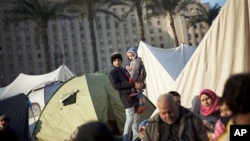
Hundreds of thousands of people rallied in Tahrir Square Tuesday in one of the biggest protests of a two-week-old uprising seeking an immediate end to Mr. Mubarak's nearly 30 years in power. Thousands remained in the square Wednesday, after spending another night in makeshift shelters.
Other activists protested for a second day outside Egypt's parliament, several blocks from the square. Some had slept on the ground overnight, hoping to block access to the building. They demanded the resignation of lawmakers elected late last year in a vote they say was rigged in favor of the ruling party.
Mr. Mubarak has responded to the protests by declaring he will not to run for a sixth term in a September election and offering other political concessions, but the protesters have rejected those pledges as superficial.
Many of those in the square Tuesday joined the protests for the first time. Some said they were inspired by the story of a 30-year old Egyptian executive at Internet giant Google, whom authorities detained in secret for 12 days after he helped to ignite the uprising with a Facebook page.
Wael Ghonim received a thunderous welcome from the crowd as he appeared in the square a day after being released from custody. In a brief address, he said, "We will not abandon our demand - the departure of the regime." MENA says Suleiman rejected that call, insisting there will be "no ending of the regime."
Suleiman also is quoted as warning against plans by some protesters for a campaign of civil disobedience, saying such a development would be "very dangerous" to society.
Thousands of Egyptian university professors and lawyers also made their first appearance at the Cairo protest site Tuesday, while anti-Mubarak activists held substantial protests in other cities such as Alexandria.
Earlier Tuesday, Vice President Suleiman said Mr. Mubarak issued decrees establishing separate committees to draft constitutional reforms and monitor their implementation. The reforms are aimed at relaxing eligibility rules for the presidency and imposing term limits - key demands of Egypt's opposition.
Suleiman said Mr. Mubarak also formed a third committee to investigate deadly fighting last week between his supporters and anti-government activists in Tahrir Square.
The Egyptian vice president held unprecedented talks with several opposition groups on Sunday, but representatives of the Cairo street protesters did not participate.
The United Nations says protest-related violence in Egypt has killed more than 300 people since January 25.
Some information for this report was provided by AP, AFP and Reuters.