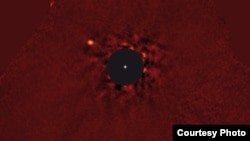
Astronomers have discovered what they’re calling a “super Jupiter” orbiting a star 170 light years away from earth.
According to astronomers at the Max Planck Institute for Astronomy in Heidelberg, Germany, the newly discovered gas giant planet has 13 times the mass of Jupiter and orbits the star Kappa Andromedae, which has a mass 2.5 times larger than our Sun.
Most exoplanets are discovered through indirect detection such as the so-called transit method, in which a small change in the light emanating from a planet’s parent star is observed as the planet orbits it.
But the Jupiter-like planet was actually photographed directly, using the Subaru telescope on Mauna Kea in Hawaii.
The direct detection of the massive planet means scientists should be able to use other means to gather further information about it, including performing an in-depth analysis of the planet’s light, as well as investigating the radiation emitted by Kappa Andromedae, which could provide insight into the planet’s atmosphere.
Scientists hope the discovery will shed light on how planets are formed, because Kappa Andromedae is a very young star--30 million years old--compared to our sun, which is 5 billion years old. This planet probably formed in a similar way to ordinary, lower-mass planets, in a “protoplanetary disk” of gas and dust.
According to astronomers at the Max Planck Institute for Astronomy in Heidelberg, Germany, the newly discovered gas giant planet has 13 times the mass of Jupiter and orbits the star Kappa Andromedae, which has a mass 2.5 times larger than our Sun.
Most exoplanets are discovered through indirect detection such as the so-called transit method, in which a small change in the light emanating from a planet’s parent star is observed as the planet orbits it.
But the Jupiter-like planet was actually photographed directly, using the Subaru telescope on Mauna Kea in Hawaii.
The direct detection of the massive planet means scientists should be able to use other means to gather further information about it, including performing an in-depth analysis of the planet’s light, as well as investigating the radiation emitted by Kappa Andromedae, which could provide insight into the planet’s atmosphere.
Scientists hope the discovery will shed light on how planets are formed, because Kappa Andromedae is a very young star--30 million years old--compared to our sun, which is 5 billion years old. This planet probably formed in a similar way to ordinary, lower-mass planets, in a “protoplanetary disk” of gas and dust.