The Nobel Committee is due to hold a ceremony Friday in the Norwegian capital, Oslo, to honor jailed Chinese dissident Liu Xiaobo, the recipient of this year's Nobel Peace prize. At the same time, authorities in China are keeping Liu's supporters in China under close surveillance.
Chinese authorities visibly stepped-up security in front of the compound where Nobel Laureate Liu Xiaobo's wife, Liu Xia, has been under house arrest since he was awarded the prestigious peace prize in October.
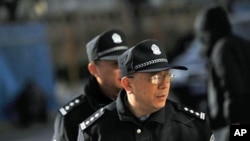
Guards checked the identities of all who entered. Police cars were positioned on every surrounding corner and security agents patrolled the compound on foot.
Chinese authorities have also been closely guarding Liu's supporters, keeping them under house arrest or tight surveillance.
On Friday, lawyer Pu Zhiqiang said security agents showed up to monitor him a day earlier, and even accompanied him on a business trip outside of Beijing.
Pu says the agents are following him because of the Nobel ceremony, which he called "pretty scary" - not because he's afraid, but because he thinks the government is. Pu says this time, the security agents told him they would stop following him on Saturday.
Others, such as journalist Li Datong, have faced restrictions on traveling overseas.
Li says he thinks he will not be allowed to travel abroad until the end of January.
At briefings this week, Foreign Ministry spokeswoman Jiang Yu was asked about the Chinese government's various restrictions on Liu's supporters, or why his wife is under house arrest even though she has committed no crime.
Although these types of questions have been asked repeatedly, Jiang has refused to give a direct answer.
Jiang says reporters should ask what she calls the "competent authorities." She also cast doubt on the accuracy of reports of house arrest or other harassment.
The Nobel Committee awarded Liu Xiaobo the Peace Prize for what it said was his "long and non-violent struggle for fundamental human rights in China." Liu is a longtime activist writer, who helped organize Charter 08, a manifesto calling for freedom of speech and political reform in China. He disappeared into detention two years ago. Last year, he was sentenced to 11-years in jail for subversion.
Chinese officials stress that legal authorities found Liu to have broken the law. Therefore, they say, awarding the Nobel prize to a Chinese criminal is an insult to China and an interference in the country's internal affairs.
The Nobel ceremony will go ahead, but the award itself will not be presented because Chinese authorities are preventing Liu's family members from attending the ceremony.
And inside China, there has been a noticeable campaign to block outside information about Liu Xiaobo and the Nobel ceremony - either by way of the Internet or through international TV news channels.
Supporters of Liu Xiaobo Under Surveillance in China