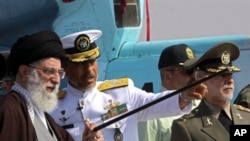
Iran's Supreme Leader Ayatollah Ali Khamenei is reiterating a previous claim that Islam is "opposed to nuclear weapons," insisting that Tehran is not trying to build them. Iran's ambassador to the International Atomic Energy Agency is also calling a leaked report that Tehran is working to build a nuclear warhead "baseless."
Iran's Supreme Leader Ayatollah Ali Khamenei christened a new, Iranian-built warship, as a military band honored him on the ship's deck. Addressing a crowd of military commanders after the ceremony, he told them that "Islam is opposed to nuclear weapons and that Tehran is not working to build them."
Iran's ambassador to the International Atomic Energy Agency (IAEA) in Vienna indicated earlier Friday that Tehran had informed the new IAEA director Yukiya Amano that it had started enriching 20 percent grade uranium for its medical research reactor in Tehran.
"Even if the nuclear agency would continue for ten more years, the result would be the same," he said. "If a new director general comes, again, [he] will report the same, because we are absolutely sure and we have assured the international community that all are activities are exclusively for peaceful purposes."
Ambassador Soltaniyah added that a leaked report claiming Tehran was trying to build a nuclear warhead is "baseless," because the documents have "no confidential or secret stamps." The West, he argued, is trying to distort the nature of Iran's nuclear program for political purposes.
"Our advice is, in fact, to stop [these] political challenges and debates in the IAEA. Let the IAEA begin new director general to focus on their purely technical and professional work," he said.
Analyst Alex Vatanka of Jane's Islamic Affairs Analyst says that Ayatollah Khamenei and President Mahmoud Ahmadinejad are the two Iranian leaders in the ongoing nuclear debate that we should listen to.
"On the nuclear issue right now, if you look at all the players, there are really two voices that we should pay attention to, one is the president, the other one is the Supreme Leader. Khamenei, realizing how weak the regime under his control has been over the past 8 or 9 months has decided to play a far more public role," he said.
"He comes in and says, there's a fatwa [Islamic ruling] here [that nuclear weapons are not permissible] and he tries to link it to other issues, like with this very harsh statement he made about Secretary Clinton, saying she's a peddler, coming here to make Iran into the big regional bogeyman and sell billions of dollars worth of arms," he added.
The Vienna-based IAEA board will begin meeting next week, and its new Japanese head Yukiya Amano will preside.
Vatanka says that Iran will use the occasion to try and sow division among board members. "The Iranians very likely in the next couple of days will start trying to create a rift in the IAEA board and in the debate."
"They're going to say al Baradei was an Arab Egyptian who had sympathy for smaller states that are trying to stand up to what they call the "global arrogance," i.e. the USA. [Amano], this new Japanese bureaucrat [they will say] is in the pocket of the West. I don't think this is going to take the debate anywhere for the Iranians. If they genuinely want a quick resolution to this all, they have to provide the kind of access to the IAEA [of their nuclear facilities] that the IAEA is asking for, which by the way on paper they are committed to," he continued.
The latest IAEA report says that inspectors have verified that none of Iran's nuclear stockpile has been diverted. Nevertheless, it adds that Tehran has "not provided the necessary cooperation to permit the agency to confirm that all nuclear material in Iran is in peaceful activities."
Iran's Supreme Leader Khamenei Says Islam Opposes Nuclear Weapons