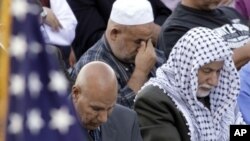



Since the 2001 terrorist attacks on New York and Washington, many Americans have worried about the potential for home grown militancy among Muslims living in the United States. A new survey of American Muslims suggests that a decade after the attacks, there is very little support for extremism.
The survey by The Pew Forum on Religion & Public Life was released just ahead of the 10th anniversary of the September 11 attacks and on the Eid al-Fitr holiday marking the end of Ramadan.
According to the survey of more than 1,000 American Muslims, only one percent said suicide bombings and other forms of violence against civilians are often justified to defend Islam from its enemies.
Pew researcher Gregory Smith says that the findings show very little support for extremism among Muslims in the United States.
"The overwhelming number say things like suicide bombings can never be justified," said Smith. "They say they have very unfavorable views of al-Qaida. We also find that Muslims in the United States are very satisfied with their lives. They're satisfied with their communities. They're satisfied with the direction of the country."
Smith notes that the 81 percent of respondents who said suicide attacks are never justified is more than double what surveys have found in some Muslim-majority countries in the Middle East.
The survey also found that around two-thirds of American Muslims say they believe that a way can be found for Israel to exist so that the rights of Palestinians are addressed. The researchers say that is significantly higher than among Muslims in the Middle East.
The Pew survey shows that many American Muslims say they like their communities. Gregory Smith says that a variety of questions on lifestyle habits such as recycling, watching sports and social networking on the Internet suggest they look very much like the rest of the American public.
"All that said, we shouldn't downplay or forget about that the survey also shows that there are some significant challenges that Muslims face in the United States," he said.
The researchers note that most of the respondents said that it has become more difficult to be a Muslim since the 2001 terrorist attacks. Around one in five said they had been singled out by airport security.
Still, nearly half said Muslim leaders in the United States have not done enough to speak out against Islamic extremists.
Survey of US Muslim Attitudes Finds Little Support for Extremism