



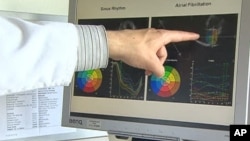
Many doctors see atrial fibrillation (AF), an abnormal heart rhythm, in their elderly patients. But a new study indicates that a surprising number of middle aged women, who are otherwise healthy, are diagnosed with AF and are at a higher risk of death.
Judy Kulp has come to Brigham and Women's Hospital in Boston to check on her atrial fibrillation.
"It feels like a middle school kid who wants to be a drummer in the band, but has no sense of rhythm," said Kulp.
Atrial fibrillation happens when electrical impulses in two of the four chambers of the heart go into an irregular or chaotic pattern. Doctors often diagnose it when patients come in with symptoms of heart papitations. It is a condition not commonly seen in middle aged women.
An international group of researchers wanted to know why, so they looked at results of the Women's Health Study, conducted from 1993 to 2010. Data was collected from 35,000 women whose average age was 53. No one in the group had previous heart problems. But surprisingly, the women with sustained atrial fibrillation had a twofold greater risk of death than others.
Dr. David Conen of the University Hospital in Basel, Switzerland and other researchers wanted to know what the risk factors were for these women, especially those who appeared to be healthy.
"There was an increased risk of death among women who developed atrial fibrillation, even in a population who was at absolutely low risk of cardiovascular disease at baseline," said Conen.
Cardiologist Christine Albert of Brigham and Women's Hospital in Boston, Massachusetts was one of the researchers. She says the key is whether the AF is constant.
"When we looked at women who had what we call paroxysmal [brief and intermittent] atrial fibrillation, which is atrial fibrillation that comes and goes, we didn't find an elevation in total mortality," said Albert.
Patients are often treated with medication to reduce high blood pressure and are urged to reduce their cholesterol levels and not to smoke. Judy Kulp underwent what's called ablation therapy, which uses catheters to suppress the atrial fibrillation.
"I feel fantastic," said Kulp. "I haven't had any symptoms. The difference of not knowing what's going to happen from day to day, to feeling great, is wonderful."
Women, and men, who feel they have symptoms of atrial fibrillation are advised to see their doctor for appropriate treatment. The study was published in the Journal of the American Medical Association.