


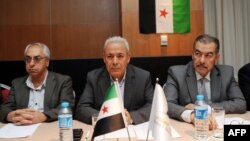
Members of the Syrian National Council, the main coordinator of opposition groups in that violence-torn nation, are gathering in Istanbul Saturday for a two-day meeting to elect a new leader. This follows the resignation last month of Burhan Ghalioun, who was the target of increasing criticism from members of the opposition coalition.
Syrians both in and outside the country, along with their international backers, have challenged the Syrian National Council's (SNC) effectiveness, and that criticism eventually forced the resignation of Burhan Ghalioun, a long-time resident of France who has been leading the SNC. The council is an umbrella group that includes many opposition factions and ethnic groups, and it has been dogged by internal wrangling.
Bassma Kodmani, a spokeswoman for the SNC, maintains it still is effective in coordinating opposition to the Assad government in Damascus.
"It has a heavy responsibility," said Kodmani. "It certainly remains a democratic entity, with the dissenting voices and differences of opinions and so on. But what gathers all these groups is one aim: it's the fall of this regime."
One of the most damaging criticisms of the Syrian National Council is that it is dominated by the Sunni Muslim, pro-Islamist Muslim Brotherhood. Observers say that is of particular concern to Syria's Alawites, followers of a branch of Shia Islam. Alawites are a minority in Syria but their members include most of the current regime's senior officials as well as President Bashar al-Assad and his family.
Similar concerns about Muslim Brotherhood domination have been expressed by elements of Syria's large Kurdish minority.
During her visit to Istanbul on Thursday, U.S. Secretary of State Hilary Clinton said more has to be done to win over all sections of Syrian society.
"There are still many inside Syria who are not convinced that there can be a transition that would not make the situation worse for them - their families, their group, their location," said Clinton.
The council maintains it represents all Syrians and is committed to a tolerant and diverse country. Spokeswoman Kodmani acknowledges there is a risk of sectarian conflict, but puts the blame on the regime.
"The answer from the regime to the uprising is: one, you crush it, and two, you divide along sectarian lines. And you incite hatred among communities," Kodmani said.
With the situation in Syria rapidly deteriorating and close to all-out civil war, delegates at the Istanbul meeting are keen to give a strong message of unity.
There is only one candidate for the Syrian National Council's leadership post: Abdul-Basset Sayda, who currently heads the organization's human rights department and lives in exile in Sweden. Sayda is Kurdish but is seen as a neutral candidate. His supporters say he will appeal to liberals, Islamists and nationalists in the opposition coalition.
Syrians both in and outside the country, along with their international backers, have challenged the Syrian National Council's (SNC) effectiveness, and that criticism eventually forced the resignation of Burhan Ghalioun, a long-time resident of France who has been leading the SNC. The council is an umbrella group that includes many opposition factions and ethnic groups, and it has been dogged by internal wrangling.
Bassma Kodmani, a spokeswoman for the SNC, maintains it still is effective in coordinating opposition to the Assad government in Damascus.
"It has a heavy responsibility," said Kodmani. "It certainly remains a democratic entity, with the dissenting voices and differences of opinions and so on. But what gathers all these groups is one aim: it's the fall of this regime."
One of the most damaging criticisms of the Syrian National Council is that it is dominated by the Sunni Muslim, pro-Islamist Muslim Brotherhood. Observers say that is of particular concern to Syria's Alawites, followers of a branch of Shia Islam. Alawites are a minority in Syria but their members include most of the current regime's senior officials as well as President Bashar al-Assad and his family.
Similar concerns about Muslim Brotherhood domination have been expressed by elements of Syria's large Kurdish minority.
During her visit to Istanbul on Thursday, U.S. Secretary of State Hilary Clinton said more has to be done to win over all sections of Syrian society.
"There are still many inside Syria who are not convinced that there can be a transition that would not make the situation worse for them - their families, their group, their location," said Clinton.
The council maintains it represents all Syrians and is committed to a tolerant and diverse country. Spokeswoman Kodmani acknowledges there is a risk of sectarian conflict, but puts the blame on the regime.
"The answer from the regime to the uprising is: one, you crush it, and two, you divide along sectarian lines. And you incite hatred among communities," Kodmani said.
With the situation in Syria rapidly deteriorating and close to all-out civil war, delegates at the Istanbul meeting are keen to give a strong message of unity.
There is only one candidate for the Syrian National Council's leadership post: Abdul-Basset Sayda, who currently heads the organization's human rights department and lives in exile in Sweden. Sayda is Kurdish but is seen as a neutral candidate. His supporters say he will appeal to liberals, Islamists and nationalists in the opposition coalition.