News / Middle East

Syria Opposition Leader Meets with Russian FM

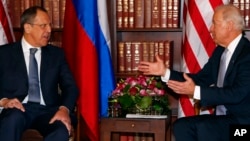
Russia's Foreign Minister Sergei Lavrov and U.S. Vice-President Joe Biden (R) meet for bilateral talks during the 49th Conference on Security Policy in Munich, February 2, 2013.
TEXT SIZE - +
VOA News
Russian Foreign Minister Sergei Lavrov has held his first direct talks with Syria's opposition leader on the sidelines of the Munich Security Conference.

The meeting Saturday between Lavrov and Moaz al-Khatib did not include U.S. Vice President Joe Biden and U.N. envoy Lakhdar Brahimi, despite initial suggestions that all four might meet in southern Germany. Biden instead held separate meetings with Lavrov, Brahimi, and al-Khatib.

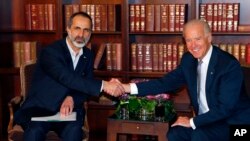
US Vice President Joe Biden, right, and Sheikh Moaz al-Khatib, Syria's top opposition leader, shake hands at the Security Conference in Munich, Germany, February 2, 2013.US Vice President Joe Biden, right, and Sheikh Moaz al-Khatib, Syria's top opposition leader, shake hands at the Security Conference in Munich, Germany, February 2, 2013.
x
US Vice President Joe Biden, right, and Sheikh Moaz al-Khatib, Syria's top opposition leader, shake hands at the Security Conference in Munich, Germany, February 2, 2013.
This year's Munich Security Conference is designed to revive efforts to find a means to end the civil war in Syria. Earlier this week, al-Khatib said he is willing to negotiate with Syrian President Bashar al-Assad's government.

The White House says the vice president emphasized during his meeting with Lavrov the importance of Russia and the U.S. working together in the interest of international peace and security.

Washington and Moscow have considerable disagreements on dealing with the Syrian crisis.

Russia's Foreign Minister Sergei Lavrov and U.S. Vice-President Joe Biden (R) meet for bilateral talks during the 49th Conference on Security Policy in Munich, February 2, 2013.Russia's Foreign Minister Sergei Lavrov and U.S. Vice-President Joe Biden (R) meet for bilateral talks during the 49th Conference on Security Policy in Munich, February 2, 2013.
x
Russia's Foreign Minister Sergei Lavrov and U.S. Vice-President Joe Biden (R) meet for bilateral talks during the 49th Conference on Security Policy in Munich, February 2, 2013.
Biden pledged continuing U.S. support for Syria's opposition at the conference, adding that President Bashar al-Assad is "no longer fit" to lead his country and "must go."

Russian Foreign Minister Sergei Lavrov said at the conference that such a condition is not acceptable.

He said the agreed-upon Geneva process for Syria must be followed, including talks among all parties. He also rejected a suggestion from an audience member for the creation of a humanitarian corridor in Syria, enforced by international air power.

"On the humanitarian corridors with close air support, no," he said. "Any use of force, any threat of the use of force will be unacceptable because the situation on the ground requires not more military assets but immediate cease-fire and immediate end of violence."

Lavrov indicated Russia is concerned that any United Nations authorization for military operations in Syria, even for humanitarian purposes, will result in wider involvement, which is what Russia believes happened with the U.N. Security Council resolution on Libya. The Damascus ally has vetoed three U.N. resolutions to mount pressure on Syrian President Bashar al-Assad.

​Civil war between Syrian rebels and the government of President Assad has gripped Syria since evolving from peaceful anti-government protests in March of 2011.

The United Nations says at least 60,000 people have been killed since the conflict began.

You May Like

South Africa to Host World's Biggest Telescope

South Africa competed against Australia to host the telescope, the final decision was to split the SKA between the two countries More

Report: Global Warming Could Reverse Development

World Bank study says warmer climates threaten advances and could exacerbate poverty in world’s poorest regions More

Video Inmates Fight Fires, Gain Skills for Life After Prison

In California, physically fit inmates with no history of violent crimes can train, work as firefighters while serving their time More

This forum has been closed.
Comment Sorting
Comments
     
by: JKF from: Ottawa, Canada
February 02, 2013 7:07 PM
I hope the talks continue and are progressive to end the civil war. Both sides of this conflict need to stop granstanding and bring this bloody conflict to an end. It is clear that well over 60,000 people are dead, mostly Sunni Muslim civilians. Both sides of this conflict need to think about the suffering of the civilians still trapped, and do what it takes to get a temporary ceasefire, followed by negotiations, including the immediate delivery of humanitarian aid to Sunni civilians trapped by the conflict. An impartial transitional gvmt is required, followed by a full permanent ceasefire, withdrawl of forces, including all foreign forces, and then elections under a UN mandated transitional force. If this conflicft does not stop, more civilians will die, and all of Syria will be rubble, causing unecessary suffering and the fragmentation of Syria..


by: Habi from: Canada
February 02, 2013 5:11 PM
"from peaceful anti-government protests"? really peaceful? Why government use violence to "peaceful people"? As far as I know, no protest is really peaceful, there are always some people in opposition group to let off steam and to express their discontent using violence, even killing. Opposition party members and anti-government protesters may lie in order to get their support from the west. It is politics!

Featured Videos

Your JavaScript is turned off or you have an old version of Adobe's Flash Player. Get the latest Flash player.
Video

Video Human Rights Film Festival Highlights Gender, Economic Issues

Twenty new films from around the world are screening in New York this week, as part of the 24th annual Human Rights Watch Film Festival, co-presented by the Film Society of Lincoln Center and IFC Center. The issues explored range from the rights of women, gays and the disabled, to economic justice, to political murder, torture and wrongful imprisonment. VOA’s Carolyn Weaver reports from New York.