News / Middle East

Moderate Syrian Cleric to Lead Opposition

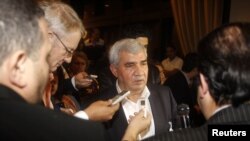
Leading Syrian dissident Riad Seif (C) speaks to the media at the meeting of the General Assembly of the Syrian National Council in Doha, November 8, 2012.
TEXT SIZE - +
VOA News

Syrian opposition groups have elected a moderate cleric, Maath al-Khatib, as the first leader of a new coalition that unites the disparate factions fighting to end the rule of President Bashar al-Assad.

Businessman Riad Seif, who proposed the U.S.-backed initiative to establish an umbrella organization of Syrian- and external-based opposition, was elected vice president on Sunday.  Suhair al-Atassi, a well-known female activist, also was elected vice president.

Khatib, a former imam at the Umayyad mosque in Damascus, was imprisoned several times for criticizing Mr. Assad's rule before he left Syria this year.

Seif had drawn up the U.S.-backed reform proposals on which Sunday's agreement, reach in Doha, was based.  Opposition figures had struggled to achieve unity, under pressure from U.S. diplomats and officials from Qatar, which have supported Syrian opposition activity since an uprising began last year.

The deal came after the Syrian National Council, which had formerly been seen as the main representative of the opposition, heeded Arab and Western pressure to agree to a new structure embracing groups that had been unwilling to join its ranks.

Meanwhile, Israeli troops fired warning shots into Syria after stray munitions from fighting between Syrian troops and rebels landed in Israel's Golan Heights area.

The military said in a statement Sunday that a mortar shell landed near an Israeli army post in the Golan Heights.  It says that Israeli soldiers fired warning shots in response. 

The statement adds that the army filed a complaint through the local United Nations forces warning that "fire emanating from Syria into Israel will not be tolerated and shall be responded to with severity".

Israel public radio said the incident was the first direct engagement between Israel and Syria since the countries' 1973 war.

You May Like

India, China Pledge to Overcome Border Tensions

Indian prime minister and Chinese premier attempt to move past tense standoff in the Himalayas during Delhi talks More

Burmese President Opens US Visit with VOA Town Hall Meeting

Ahead of his meeting with President Obama Monday, Thein Sein answered questions on human rights and economic development in his country More

Video Washington Week: Focus on Burma, US Government Scandals

President Thein Sein visits the White House on Monday, Congressional probes of multiple scandals are continuing More

This forum has been closed.
Comments
     
There are no comments in this forum. Be first and add one

Featured Videos

Your JavaScript is turned off or you have an old version of Adobe's Flash Player. Get the latest Flash player.
Video

Video Boston Bomber Spent 6 Months in Russia’s Most Violent Republic

The news of the Boston Marathon bombings circled the globe, and resonated here in Dagestan, a majority Muslim republic in Russia, on the shores of the Caspian Sea. Last year, Tamerlan Tsarnaev, the older of two brothers suspected of the bombings and a long-time Boston resident, returned to Dagestan, where he had lived for a year during his youth. Dagestan was the land of his maternal ancestors. But in the last two years, this republic of 3 million people has gained notoriety as the region with the highest level of political and religious violence in all of Russia. VOA's James Brooke reports from Makhachkala, Russia.