Activists say Syrian government warplanes targeted an olive press factory near the city of Idlib Tuesday, in the country's north, killing at least 20 people. They say dozens more have been wounded.
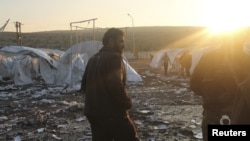
Video released Tuesday also shows the aftermath of a government airstrike on an unfinished refugee camp in Bab Al-Hawa, near the Syrian-Turkish border. There were no immediate reports of injuries.
The Syrian Observatory for Human Rights says violence across the country has killed more than 40,000 people since the uprising against President Bashar al-Assad began in March of last year.
The United Nations fears the crisis is only going to worsen.
U.N. Under-Secretary-General for Humanitarian Affairs Valerie Amos visited the Zaatari refugee camp Tuesday in Jordan, near the Syrian border, taking time to talk to refugees and their children.
Amos described the situation as bleak.
"This camp already hosts over 30,000 people, we anticipate that more will come, half of them are children, you can see the anger, the fear, the resentment, there is considerable trauma here," she said.
Many of those at the refugee camp say there are barely enough supplies to meet their most basic needs.
"The situation is very bad, it is cold, as you see, the tents let rainwater in, water goes into the tents, the children are freezing, there are no blankets to keep the women and children warm,'' said refugee Mohammed Ali Samara.
The UNHCR's Amos said relief workers can only do so much.
"We will do all we can to help the refugees and the people of Syria, but this requires the international community to come together, to work together and to find a political solution which meets the needs of the Syrian people," she said.
The UNHCR says the number of Syrian refugees has doubled since September, totaling 442,000, but that the figure does not include the many Syrians who have not registered with relief agencies.
Separately, video posted online Tuesday appeared to show Syrian rebels shooting down a military helicopter.
The video - which goes on to show the helicopter crashing into a field - cannot be independently confirmed. But some opposition activists, like British-based Abdul Omar, say they remain hopeful.
"The rebels have become much more organized over the past month or so and they are bringing the fight much, much closer to Assad's key, strategic military bases," said Omar.
Omar told VOA that what seems to be holding the rebels back, more than anything, is the sheer size and scope of the regime's military apparatus.
"Those who are optimistic among us would say that the rebels with the support that they have received, in terms of logistical support and training, are actually able to conduct some highly risky operations and so far they seem to be gaining ground. The problem is that this has been happening slowly," said Omar.
Also Tuesday, Human Rights Watch said there was "compelling evidence" a Syrian government jet dropped two cluster bombs on a rebel-held village near Damascus, killing 11 children.
HRW based its assessment on witness interviews and on video posted to the Internet. The group said markings on the remnants of the cluster bomb indicate it was made in the Soviet Union in the 1970s.
The Syrian army has denied a HRW report issued in October that government forces have used cluster bombs, saying it did not possess such weapons. Cluster bombs are banned under a 2010 U.N. treaty, although Syria, like Israel, Russia and the United States, has not signed the pact.
Video released Tuesday also shows the aftermath of a government airstrike on an unfinished refugee camp in Bab Al-Hawa, near the Syrian-Turkish border. There were no immediate reports of injuries.
The Syrian Observatory for Human Rights says violence across the country has killed more than 40,000 people since the uprising against President Bashar al-Assad began in March of last year.
The United Nations fears the crisis is only going to worsen.
U.N. Under-Secretary-General for Humanitarian Affairs Valerie Amos visited the Zaatari refugee camp Tuesday in Jordan, near the Syrian border, taking time to talk to refugees and their children.
Amos described the situation as bleak.
"This camp already hosts over 30,000 people, we anticipate that more will come, half of them are children, you can see the anger, the fear, the resentment, there is considerable trauma here," she said.
Many of those at the refugee camp say there are barely enough supplies to meet their most basic needs.
"The situation is very bad, it is cold, as you see, the tents let rainwater in, water goes into the tents, the children are freezing, there are no blankets to keep the women and children warm,'' said refugee Mohammed Ali Samara.
The UNHCR's Amos said relief workers can only do so much.
"We will do all we can to help the refugees and the people of Syria, but this requires the international community to come together, to work together and to find a political solution which meets the needs of the Syrian people," she said.
The UNHCR says the number of Syrian refugees has doubled since September, totaling 442,000, but that the figure does not include the many Syrians who have not registered with relief agencies.
Separately, video posted online Tuesday appeared to show Syrian rebels shooting down a military helicopter.
The video - which goes on to show the helicopter crashing into a field - cannot be independently confirmed. But some opposition activists, like British-based Abdul Omar, say they remain hopeful.
"The rebels have become much more organized over the past month or so and they are bringing the fight much, much closer to Assad's key, strategic military bases," said Omar.
Omar told VOA that what seems to be holding the rebels back, more than anything, is the sheer size and scope of the regime's military apparatus.
"Those who are optimistic among us would say that the rebels with the support that they have received, in terms of logistical support and training, are actually able to conduct some highly risky operations and so far they seem to be gaining ground. The problem is that this has been happening slowly," said Omar.
Also Tuesday, Human Rights Watch said there was "compelling evidence" a Syrian government jet dropped two cluster bombs on a rebel-held village near Damascus, killing 11 children.
HRW based its assessment on witness interviews and on video posted to the Internet. The group said markings on the remnants of the cluster bomb indicate it was made in the Soviet Union in the 1970s.
The Syrian army has denied a HRW report issued in October that government forces have used cluster bombs, saying it did not possess such weapons. Cluster bombs are banned under a 2010 U.N. treaty, although Syria, like Israel, Russia and the United States, has not signed the pact.