



News / Middle East

Syria Gets New Government as Demonstrations Continue

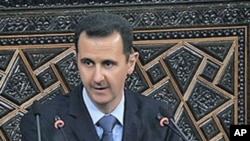
Syrian President Bashar al-Assad addresses the nation during a speech in Damascus, Syria
TEXT SIZE - +

Syrian President Bashar al-Assad on Sunday appointed a former agriculture minister as the country's new prime minister and asked him to form a government -- as thousands turned out in the city of Douma for the funerals of eight protesters killed on Friday.

Abdel Safar, a member of the ruling Baath Party, replaces Mohammad Najo Otri, who quit last Tuesday along with his Cabinet following a wave of anti-government protests calling for political reform.

Human rights groups say more than 60 people have been killed by security forces since the unrest began two weeks ago.  But the government has blamed the deaths and the unrest on "armed groups."

Douma, a suburb of the Syrian capital of Damascus, is one of several cities which has witnessed protests against the 11-year-rule of Mr. Assad and the decades of authority of the Assad family.

Safar was dean of Damascus University's agricultural faculty until 2003 when he became a member of the Cabinet that resigned last week.  

Besides naming a new government, Mr. Assad has also called for reforms including the creation of a committee to study the possibility of lifting the country's emergency law, which bans political activity not approved by the government.  Abolishing the emergency law has been a key demand of the protesters.

Some information for this report was provided by AP, AFP and Reuters.

Follow our Middle East reports on Twitter
and discuss them on our Facebook page.

You May Like

Experts Weigh In on Challenges of Closing Guantanamo Prison

Former chief military prosecutor at Guantanamo delivers petition to White House with more than 370,000 signatures, demanding facility be closed down immediately More

Karzai to Discuss Enhancing Defense Ties with India

Afghanistan looking for more military aid as it prepares for withdrawal of NATO forces by next year More

India, China Pledge to Overcome Border Tensions

Indian prime minister and Chinese premier attempt to move past tense standoff in the Himalayas during Delhi talks More

Burmese President Opens US Visit with VOA Town Hall Meeting

Ahead of his meeting with President Obama Monday, Thein Sein answered questions on human rights and economic development in his country More

This forum has been closed.
Comments
     
There are no comments in this forum. Be first and add one

Featured Videos

Your JavaScript is turned off or you have an old version of Adobe's Flash Player. Get the latest Flash player.
Video

Video US Oil Surge Could Impact Mideast Geopolitics

The United States will account for a third of new oil supplies over the next five years, and will become energy self-sufficient in 20 years, according to a new report by the Paris-based International Energy Agency (IEA). Although U.S. oil imports from Arab Gulf countries increased last year, analysts predict the U.S. will lose its dependence on Middle East imports, which is expected to have a huge impact on international relations and the balance of power. VOA's Henry Ridgewell reports.