



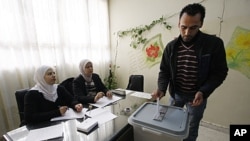
Despite violence that continues to roil the country, Syria's government is holding local council elections Monday as it downplays anti-government unrest as the work of a small group of foreign-backed terrorists.
In Syria's northern, heavily Kurdish province of Hasaka a crowd chants slogans against local council elections taking place across the country Monday. Witnesses say voter turnout for the elections across the country was light.
Watch Syria video clip:
But Judge Khalaf Azawi, who heads Syria's electoral commission, told journalists that the voting process was a success and that many voters turned out to cast their ballots.
He says the democratic process was positive, thanks to the a electoral law which guarantees that elections take place in a free, democratic, and transparent way. He adds that voter turnout seemed heavy, during his visits to polling stations, showing democracy at work.
But in a suburb of Syria's second largest city of Aleppo, opposition activists crumpled and burned election posters, calling candidates “government lackies.” Parts of Aleppo and many other Syrian towns and cities took part Monday in the second day of an opposition-led general strike.
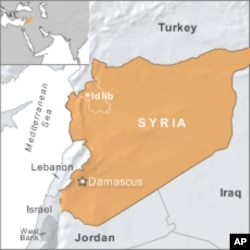
In a video on an opposition website, a mostly young crowd participated in what appeared to be a mock election in Syria's northern Idlib province. Young men placed paper ballots into a plastic voting box, with slogans of “regime change,” “resignation” of President Assad, and “a new government,” into the box.
Syria's Information Minister, Adnan Mahmoud, said given that the elections took place during the current political conditions, it demonstrated that they were a success.
He stresses that the elections happened on schedule, despite the current events that Syria is living through, showing the resolve of Syrian leaders in moving forward.
Timor Goksel, who teaches at the American University of Beirut, argues that the elections are a step in the right direction, but could be too little, too late.
“Although I can say it's a positive step, it seems to be a bit too late," said Goksel. "These are the sort of moves they could have done at the beginning without taking on the people and making this a regime-change war. Now, whether it will be a beginning step or a remedy, I'm not sure. I'm not sure how effective it will be.”
The government has also scheduled to hold parliament elections in February.
| Join the conversation on our social journalism site - Middle East Voices. Follow our Middle East reports on Twitter and discuss them on our Facebook page. |