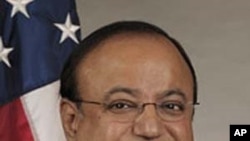
U.S. Assistant Commerce Secretary Suresh Kumar is visiting Taiwan this week to promote American exports on an island where people have money to spend, despite world economic turmoil. Kumar is the most-senior U.S. official to visit Taiwan in five years -- a public diplomatic boost for the island since China normally condemns Taipei’s ties with the United States.
Suresh Kumar, the U.S. assistant secretary for trade promotion, is visiting Taiwan to advance the National Export Initiative, aimed at doubling American exports in five years and creating some two million American jobs. Taiwan’s economy is forecast to grow five percent this year, improving the Taiwanese ability to purchase American specialties such as beef, wine, travel and higher education.
Last year exports to Taiwan surged 41 percent, to $26 billion. Kumar told a group of some 100 Taiwan-based business people Wednesday that the country is poised to move up a spot to the ninth largest U.S. trading partner in 2011.
“While our trade relations are strong, the opportunities for further growth are immense," said Kumar. "Please let me make this extremely clear -- economic partnership between United States and Taiwan businesses is here to say. Both sides are committed and eager to work together and write new and prosperous chapters in our commercial relationship.”
Kumar’s visit, the highest level one from Washington since Deputy Trade Representative Karan Bhatia came to promote Washington's trade agenda in 2006, shows that the island is still an influential hub for international business and trade, despite the risk of backlash from Beijing.
China has claimed Taiwan as part of its territory since the Chinese civil war of the 1940s. Beijing normally forbids its more than 170 diplomatic allies, including the United States, from making formal contact with the self-ruled island. Officials in Washington hope to avoid harsh words from Beijing as they seek deeper relations with world economic powerhouse.
Kumar met privately on Wednesday with Taiwan President Ma Ying-jeou, as Mr. Ma steps up a campaign for reelection at the polls on January 14. His platform rests partly on proving he can maintain ties with world powers despite opposition from China. Alexander Huang, a strategic studies professor at Tamkang University in Taiwan, says Kumar’s visit has domestic political implications for President Ma.
“Kumar’s visit is also very meaningful and important for the government of Taiwan because Taiwan has always put high on the agenda inviting and hoping that the United States executive branch officials can visit Taiwan to raise the profile of U.S.-Taiwan relations, especially in this campaign year for the president next January," said Huang. "I think Kumar’s visit will boost the image of sitting President Ma Ying-jeou and also can give the government another round of evidence to show how good the U.S.-Taiwan relationship is.”
President Ma has sought better ties with China by brokering trade talks since taking office in 2008, so officials in Beijing have lashed out less often at the island’s foreign policy.
China did not formally protest the 2006 visit, nor has it publicly objected to Kumar’s trip as he stops in Taiwan en route to trade promotion events in Southeast Asia.
Local media reported Taiwan’s president told Kumar that a market-opening pact that his negotiator signed with Beijing last year could open China to joint Taiwanese-American business ventures.
Taiwan Hosts Visit of Highest-Level US Envoy in Five Years