


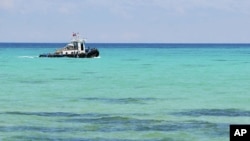
TAIPEI, Taiwan — A group of Taiwanese legislators landed on an islet in the hotly disputed South China Sea to inspect the level of coast guard protection for its claims in the Spratly archipelago. Because of its unique political status, Taiwan, normally keeps quiet about its claims to the resource-rich ocean.
A transport aircraft carrying about 30 people led by a group of lawmakers reached Taiping Island early Tuesday.
Taiwan’s coast guard, which protects the tiny coral island, matched the legislative visit with a series of live-fire exercises using more than 140 grenades, mortars and machine guns. Group leader and legislator Lin Yu-fang led a group to the same islet in April and found defenses to be inadequate.
Lin told a news conference Taiwan can now defend the small islet.
He says that after the April visit he did not expect the level of defense for Taiping Island could be strengthened so fast. But based on his trip Tuesday, the lawmaker says, the coast guard looks ready to defend Taiwan’s southernmost piece of land.
On Saturday, Taiwan’s Interior Ministry said the top governmental security adviser had just visited Taiping Island. The government said later that day Taiwan wanted to be a peacemaker by sharing its experience in managing the islet that supports a hospital and an airstrip.
Taiwan adds that it is also willing to offer humanitarian aid and advice on global warming in the South China Sea. Taiping belongs to the Spratly Chain and is one of about 500 islets in the disputed ocean area.
The ocean area stretching from Taiwan to Singapore is also claimed, all or in part, by China, Brunei, Malaysia, Vietnam and the Philippines. The expanse of 3.5-million square kilometers is believed to be rich in undersea oil or natural gas, and most claimants have launched explorations.
Competing claims have sparked naval clashes in other parts of the ocean, including deadly ones in 1974 and 1988, but few involving Taiwan. The South China Sea dispute has escalated this year with a long standoff between the Philippines and an increasingly aggressive China.
The United States has further irritated China, which is hungry for fish and oil, by asking that it cooperate more with the smaller claimants.
Taiwan cannot assert itself like other governments in the region. China claims not only the sea, but also Taiwan. Beijing bars its numerous diplomatic allies in Asia from discussing political matters with officials in Taipei.
Taiwan was unable to join when China met rival claimants earlier this year to discuss a South China Sea code of conduct, talks that ultimately collapsed.
On a visit to Asia this week, U.S. Secretary of State Hillary Clinton again urged China and Southeast Asian nations to work out the code of conduct.
Vietnam has protested in the past over Taiwan’s visits to the South China Sea. But responses from rival claimants this week have been muted. Taiwanese Foreign Ministry spokesman Steve Hsia does not expect a major outcry.
He says that Taiwan’s activities on Taiping Island are legal. Because those moves are backed by law, he says, the Foreign Ministry does believe they will cause no regional anxiety among neighboring countries.
Political analysts in Taipei say foreign governments know they need not worry. They call the South China Sea visits a response to pressure at home for stronger foreign policy, especially as China grows more powerful. President Ma’s government has reduced tensions with China since taking office in 2008, but China has never renounced the use of force to assert its sovereignty over Taiwan.
A transport aircraft carrying about 30 people led by a group of lawmakers reached Taiping Island early Tuesday.
Taiwan’s coast guard, which protects the tiny coral island, matched the legislative visit with a series of live-fire exercises using more than 140 grenades, mortars and machine guns. Group leader and legislator Lin Yu-fang led a group to the same islet in April and found defenses to be inadequate.
Lin told a news conference Taiwan can now defend the small islet.
He says that after the April visit he did not expect the level of defense for Taiping Island could be strengthened so fast. But based on his trip Tuesday, the lawmaker says, the coast guard looks ready to defend Taiwan’s southernmost piece of land.
On Saturday, Taiwan’s Interior Ministry said the top governmental security adviser had just visited Taiping Island. The government said later that day Taiwan wanted to be a peacemaker by sharing its experience in managing the islet that supports a hospital and an airstrip.
Taiwan adds that it is also willing to offer humanitarian aid and advice on global warming in the South China Sea. Taiping belongs to the Spratly Chain and is one of about 500 islets in the disputed ocean area.
The ocean area stretching from Taiwan to Singapore is also claimed, all or in part, by China, Brunei, Malaysia, Vietnam and the Philippines. The expanse of 3.5-million square kilometers is believed to be rich in undersea oil or natural gas, and most claimants have launched explorations.
Competing claims have sparked naval clashes in other parts of the ocean, including deadly ones in 1974 and 1988, but few involving Taiwan. The South China Sea dispute has escalated this year with a long standoff between the Philippines and an increasingly aggressive China.
The United States has further irritated China, which is hungry for fish and oil, by asking that it cooperate more with the smaller claimants.
Taiwan cannot assert itself like other governments in the region. China claims not only the sea, but also Taiwan. Beijing bars its numerous diplomatic allies in Asia from discussing political matters with officials in Taipei.
Taiwan was unable to join when China met rival claimants earlier this year to discuss a South China Sea code of conduct, talks that ultimately collapsed.
On a visit to Asia this week, U.S. Secretary of State Hillary Clinton again urged China and Southeast Asian nations to work out the code of conduct.
Vietnam has protested in the past over Taiwan’s visits to the South China Sea. But responses from rival claimants this week have been muted. Taiwanese Foreign Ministry spokesman Steve Hsia does not expect a major outcry.
He says that Taiwan’s activities on Taiping Island are legal. Because those moves are backed by law, he says, the Foreign Ministry does believe they will cause no regional anxiety among neighboring countries.
Political analysts in Taipei say foreign governments know they need not worry. They call the South China Sea visits a response to pressure at home for stronger foreign policy, especially as China grows more powerful. President Ma’s government has reduced tensions with China since taking office in 2008, but China has never renounced the use of force to assert its sovereignty over Taiwan.