


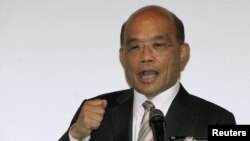
TAIPEI - The new chairman of Taiwan’s normally anti-Beijing opposition party is urging a flexible working relationship with China. That stance by the head of the Democratic Progressive Party could bring a thaw to a history of icy relations between Taiwan and China.
Taiwan’s Democratic Progressive Party chairman Su Tseng-chang said shortly after accepting the job on Sunday that he wants to keep the door open to China. He described the long-time military and political rival of Taiwan as a dynamic place that deserves flexibility from Taiwanese policy makers. Su also did not rule out a visit to China, and he would be the first Democratic Progressive party chief to make that trip.
Under the former Democratic Progressive president of Taiwan, Chen Shui-bian, relations between Beijing and Taipei were tense as Mr. Chen pushed for the self-ruled island to become an independent nation. Shane Lee, a political scientist at Chang Jung Christian University in Taiwan, says the new Democratic Progressive chairman stands out by not openly advocating that the two sides treat each other as separate countries.
"He does things as he sees fit, which means he would adjust his sails as the wind blows, so to speak, whereas Chen Shui-bian was very clear about Taiwan’s position as a country that is equal to China," said Lee.
China has seen Taiwan as part of its territory since the Chinese civil war of the 1940s and has threatened the use of force to push for eventual reunification. Current Taiwan President Ma Ying-jeou of the Nationalist Party has improved ties with the mainland. His government put political differences aside to discuss trade and investment, resulting in 16 deals worth billions of dollars to the island economy.
A conciliatory view toward China by Taiwan’s historically anti-Beijing opposition party would help keep relations stable if that party retook the presidency. The next election is in 2016.
Factions of Su’s party still believe that Taiwan cannot trust China and must seek formal independence despite a sure backlash from Beijing. But party moderates, who are backed by Taiwanese entrepreneurs with business in China, want to engage Beijing as long as the Communist leadership treats Taiwan as an equal at the bargaining table.
China is Taiwan’s top export destination, and two-way trade totals about $150 billion per year.
Taiwan’s Democratic Progressive Party chairman Su Tseng-chang said shortly after accepting the job on Sunday that he wants to keep the door open to China. He described the long-time military and political rival of Taiwan as a dynamic place that deserves flexibility from Taiwanese policy makers. Su also did not rule out a visit to China, and he would be the first Democratic Progressive party chief to make that trip.
Under the former Democratic Progressive president of Taiwan, Chen Shui-bian, relations between Beijing and Taipei were tense as Mr. Chen pushed for the self-ruled island to become an independent nation. Shane Lee, a political scientist at Chang Jung Christian University in Taiwan, says the new Democratic Progressive chairman stands out by not openly advocating that the two sides treat each other as separate countries.
"He does things as he sees fit, which means he would adjust his sails as the wind blows, so to speak, whereas Chen Shui-bian was very clear about Taiwan’s position as a country that is equal to China," said Lee.
China has seen Taiwan as part of its territory since the Chinese civil war of the 1940s and has threatened the use of force to push for eventual reunification. Current Taiwan President Ma Ying-jeou of the Nationalist Party has improved ties with the mainland. His government put political differences aside to discuss trade and investment, resulting in 16 deals worth billions of dollars to the island economy.
A conciliatory view toward China by Taiwan’s historically anti-Beijing opposition party would help keep relations stable if that party retook the presidency. The next election is in 2016.
Factions of Su’s party still believe that Taiwan cannot trust China and must seek formal independence despite a sure backlash from Beijing. But party moderates, who are backed by Taiwanese entrepreneurs with business in China, want to engage Beijing as long as the Communist leadership treats Taiwan as an equal at the bargaining table.
China is Taiwan’s top export destination, and two-way trade totals about $150 billion per year.