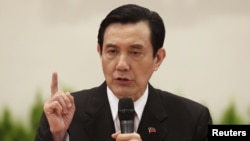
Taiwan President Ma Ying-jeou during a news conference after his inauguration ceremony at the Presidential Office in Taipei, May 20, 2012
TAIPEI - Taiwan President Ma Ying-jeou began his second term in office on Sunday with a forecast for deeper relations with old rival China. But he said a formal peace accord was not urgent. His comments came amid two days of street demonstrations.
The Taiwanese president, who was first elected in 2008 on pledges to ease tension with rising military power China, said he would stick to that course. President Ma Ying-jeou said he expected more deals like the 16 trade, transit and economic agreements that were signed between the two sides over the past four years.
But President Ma told a news conference he was in no hurry to sign a formal peace accord with Beijing without popular support. He was criticized after making the suggestion last year.
He says Taiwan will handle easy but pressing issues with China before tackling harder ones and consider economic issues ahead of political ones. In that spirit, he says, there is no urgency to discuss a peace accord now with China, and Taiwan’s people must first express a high level of support, including a voter referendum.
The 61-year-old president, who won re-election by a slim margin in January, also told reporters on Sunday that the public already endorses the current pace set for improving ties with China. Forty-five percent of Taiwanese people support the current pace, with smaller numbers favoring speeding up or slowing down the process. Ties were frozen, and tensions were high, before 2008.
Deals signed with the Asian economic powerhouse just 160 kilometers away are worth billions of dollars to Taiwanese companies. The pacts are also credited with improving Taiwan’s export competitiveness in Asia.
Communist China has claimed sovereignty over self-ruled Taiwan since the Chinese civil war of the 1940s, and has not ruled out the use of military force to maintain that sovereignty. Ma’s Nationalist Party, which once ruled all of China, fled to Taiwan in that decade and re-established a rival government. Beijing has welcomed the talks as it hopes they lead to political dialogue and eventual reunification.
Protesters throw eggs at a portrait of Taiwan's President Ma Ying-jeou during a demonstration in Taipei, May 20, 2012.
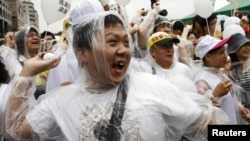
But thousands of anti-government protesters took to the streets of Taipei on Saturday and Sunday, tying up traffic as they shouted slogans and blasted air horns. Domestic issues such as the wealth gap dominated their agenda, but some were worried that Ma’s government has already veered too close to Beijing.
Protester Chen Hsien-che, a 50-year-old cosmetics worker from northern Taiwan, says he is concerned that the president’s policies will allow Taiwan to be consumed by the Communist rival.
He says Taiwanese people are definitely worried, because they have lived on the island for so long that as a people who cherish peace and love freedom they would not survive the sudden impact of Chinese rule.
President Ma said on Sunday he had heard the public’s voice. But his government has said it expects to sign an investment protection guarantee with China this year, helping about a million of the island’s business people. Officials on the island also expect to cut thousands of import tariffs and lower barriers for Chinese investors interested in Taiwanese companies, all before Ma leaves office in 2016.