


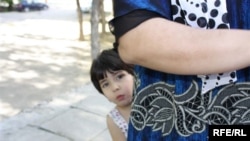
Ten-year-old Nigora has grown used to seeing her father and brother just once a year.
Both men left Tajikistan several years ago to find regular work in Russia. But one month ago, her mother left as well, putting Nigora in the care of an older sister. This is something she has found harder to take.
"I don't know what my father does there," she says. "But my mother works as a seamstress. My brother makes tables and chairs. My mom left a month ago, but my brother and father left many years ago. They call me every day, but I still miss them. My mom told me that when they buy a place [in Russia], they will bring us all there."
Some 1 million Tajiks are estimated to be living and working outside their country, settling temporarily in Russia or other countries to find work.
It's a massive drain in a country of less than 8 million people. But it's labor migration that keeps impoverished Tajikistan afloat, with remittances of $3 billion accounting for nearly half of the country's GDP.
For years, it was men who traditionally left the country to make money. But since the global financial crisis in 2008-09, Tajik women have begun making the journey as well, accounting for as much as one-sixth of the outflow.
More Than They Bargained For
Many are able to find work as housekeepers, nannies, and cleaners. But their exodus has created a new demographic reality in Tajikistan: thousands of parentless children, left in the care of older siblings or more often grandparents, for years at a time.
Grandparents often serve as surrogate babysitters in close-knit Tajik families. But many say the daily rigors of full-time child care are more than they bargained for - and hard on the children as well.
Mamurbi, a 70-year-old pensioner living in the town of Qurghonteppa, some 100 kilometers south of Dushanbe, has been left taking care of seven grandchildren between the ages of 14 and 4.
Mamurbi raised three children of her own, but that hasn't been enough to prepare her for the realities of acting as disciplinarian in her newly unruly household.
"I try my best to do as much as I can," she says. "Mostly with kindness, but sometimes by force. I say to them, 'My dear children, don't do this.' But it's very difficult to bring up children without a man in the house. Thank God they listen to their uncle."
In Tursunzoda, a town near the Uzbek border, 60-year-old Shamsiya Shoimardonova is facing a similar dilemma. She says she "couldn't say no" when her daughter decided to leave for Russia and asked her mother to take in her four children. But now she says she has "slight regrets."
"Three of my grandchildren are hitting puberty, and it's very hard to find a common language with them," says Shoimardonova, who still works as a teacher at a children's art center.
She adds that the sheer physical labor is more than she accounted for. "During my lunch break I go home and make them a meal and then I go back to work. Then in the evening I go home and cook again, in addition to cleaning the house and doing the laundry," she says. "I'm already old. It's difficult for me."
'Deprived Of A Bright Future'
Few in Tajikistan deny the importance of remittances sent home by migrants like Shoimardonova's daughter, which can help pay for improved health care, education, and nutrition. But many say that two-parent migration leaves children exposed to a host of new problems.
In a report issued in November 2011, the UN Children's Fund (UNICEF) said many Tajik children left behind by labor-migrant parents were vulnerable to bullying and suffered from depression and increased aggression.
According to Faizali Sukur, a sociologist in Dushanbe, parents should think twice about the two of them migrating, regardless of the financial benefits. "Those who have left their children here in Tajikistan and leave as labor migrants are making a serious mistake," he says.
"You can't expect anything good to come of a child who grows up without constant parental supervision. Children are like young branches - you can bend them in whatever direction you like. Most of these children don't have a good education. They're being deprived of a bright future."
In Tursunzoda, Shoimardonova feels much the same. She thought her teaching experience would make it easy to take over care of her grandchildren. But she maintains that a grandparent, can never replace a parent.
"Sometimes the children remember their parents, and they start to cry," she says. "When I see that, I have to go to my bedroom and cry myself, in private."
Written in Prague by Daisy Sindelar based on reporting by Sohibai Karomatullo in Dushanbe
| This article originally appeared at RFE/RL |