


As fundamentalist violence spreads in Afghanistan, neighboring Tajikistan is moving to control Islamic practices and to curb foreign influence.
First, women were banned from mosques in Tajikistan. Then, a few weeks ago the government banned children under 18 from mosques.
Tajikistan’s population is 98 percent Muslim. But it shares a long border with Afghanistan. The Russian-backed government here wants to keep out radicalism.
Zafar Adullayev, a blogger here, supports the new restrictions. He says the government is taking a middle road between the religious repression of the Soviet era and modern day Islamic fundamentalists who want imposition of sharia law in this traditionally moderate nation.
To limit foreign influence on traditional Islamic practices here, the government last year called home 2,000 Tajik students who were studying in overseas religious schools.
In addition, the government discourages men from wearing beards and women from wearing the tight fitting hijab. Instead women are to wear Central Asia’s traditional, loose fitting, head scarves.
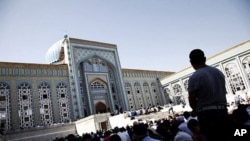
At Dushanbe’s main mosque, Abu Bakr, a 28-year-old bank worker, agrees with the new laws.
Recalling his own youth, he says teenagers are often immature hooligans. He says wisdom comes with age.
But Muhiddin Kabiri predicts government restrictions will backfire. He leads the Islamic Revival Party of Tajikistan, the only Islamic party legally registered in the former Soviet Union.
He says that government controls will push Islam underground, away from moderation and toward “Talibanism.”
With mosques closed to teenagers and most neighborhoods lacking Koranic schools, Kabiri says curious teenagers will learn about Islam through the Internet.
Once on the web, he says, young people easily end up on sites maintained by extremists.
Fifteen years ago, Kabiri’s followers lost a civil war against the secular forces of Emomali Rakhmon, Tajikistan’s Soviet-trained president. Today, Rakhmon is still president, and he is not letting his guard down.
In October, he broke ground here on what is to be the largest mosque in Central Asia.
Largely financed by Qatar, this $100 million mosque is to hold 115,000 worshippers - about one half of the capital’s adult male population.
To channel the faithful into this official mosque, President Rakhmon’s government this year started to close hundreds of neighborhood mosques and madrasahs, or Koranic schools.
Adbullah is the Imam of one neighborhood mosque. He supports the president’s position that parents should be society’s main teachers of Islam.
He says: “Our respected president, Emomali Rahmon said on television that there should be a Koran and a copy of the Constitution in every house.”
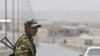
But, with more Tajiks living in Afghanistan, than in Tajikistan, the threat is always real of destabilization coming up from the south.
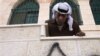
Last month, a Tajik-speaking man dressed in Afghan clothes claimed credit for Tajikistan’s first suicide car bombing, an attack that took three lives last year.
As terrorism spreads in Afghanistan, time will tell whether Tajikistan’s tactics will help - or hurt - in the fight to curb religious radicalism.