



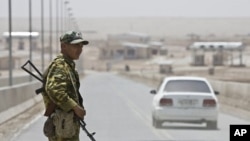
As instability spreads in Afghanistan, neighboring Tajikistan seeks to hold the line at the border.
The newly paved road from Dushanbe, Tajikistan’s capital, passes a Tajik army training base, as well as three Russian bases, home to some 6,000 soldiers - the largest deployment of Russian army troops outside of Russia.
But as one approaches Afghanistan, and a new $40 million, American-built bridge at Panji Poyon, police stop traffic one kilometer from the river border.
More Tajiks live across the river in Afghanistan than in Tajikistan. But on the Tajikistan side, all road crossings are closed.
Back in Dushanbe, tight border controls are defended by Sayfullo Safarov, deputy director of the Center for Strategic Studies, a government-affiliated think tank.
Safarov defends the tight controls as a way to stop opium flowing north from Afghanistan.
But Zafar Abdullayev, an online blogger, says few people use drugs in this Muslim-majority nation.
He says the real threat to Tajikistan from Afghanistan is Taliban-style Islamist radicalism.
Tajikistan got a jolt in September when a Taliban suicide bomber killed Burhanuddin Rabbani, the de facto leader of the 8 million Tajiks living in Afghanistan.
Rabbani, a former Afghan president, was leading peace talks with the Taliban. He was killed four days before he was to attend a meeting in Dushanbe.
At an Afghanistan conference in Dushanbe, Abdul Ghafour Arezou, Kabul's new ambassador here, blames the violence on what he calls "outside forces."
He says that the main ethnic groups of Afghanistan - Tajiks, Pashtuns and Baluchis - can live in peace.
But some analysts say Afghan history risks repeating itself. In the 1990s, Rabbani was a leader of the Northern Alliance. Now this anti-Taliban coalition reportedly is re-emerging.
Ismoil Rakhmatov, who teaches history in Dushanbe, says that the Tajik-led Northern Alliance is a powerful group with wide support in northern Afghanistan.
As the United States cuts troop levels in Afghanistan, securing Tajikistan’s southern border is a growing priority.
Sealing this long border separates Tajiks on both sides. But with instability spreading in Afghanistan, the move is an attempt to block the spread of Taliban-style extremism north into Central Asia.
Daily Life in Tajikistan