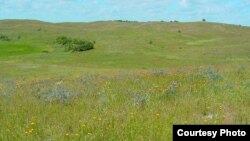
Delicate flowers pop up in the Kansas tallgrass prairie. (US Fish and Wildlife Service)
But it’s only a fraction of the 'Sea of Grass' that once grew there
One-third of North America - stretching from what is now Indiana in the Midwest westward to the Rocky Mountains - and northward from Texas deep into Canada - was once uninterrupted prairie, where Plains Indians hunted free-roaming bison, elk and antelope.
A “sea of grass,” the first Europeans called the never-ending prairie. Others called it the “Great American Desert,” thinking that nothing but wild grasses and flowers could grow there.
They were wrong. That sea of grass is now America’s breadbasket.
But following more than a century of settlement and cultivation, only two significant pieces of the great tallgrass prairie survive, on hills in eastern Kansas too rugged to farm.
Ranchers bring their cattle - and a herd or two of bison - there to graze where millions of bison once tramped.
In 1996, the nation’s only tallgrass preserve was established when the owners of the Z Bar-Spring Hill Ranch sold their 4,000-hectare property. Not to the federal government but to a private organization called the National Park Trust.
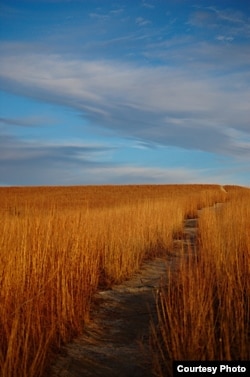
A footpath winds through the Konza preserve. (earlycj5, Flickr Creative Commons)
Thus, the Tallgrass Prairie National Preserve became the nation’s only privately owned national park. But government employees manage it and give tours.
It’s a land of subtle beauty, especially when the sun gets low and grasses produce spooky shadows. And in winter, when ice storms create a frozen wonderland.
Four kinds of grasses thrive there: big bluestem, little bluestem, switchgrass, and Indiangrass. Each flowers differently in the spring. And waves slowly nearly every day, since the wind seems to always blow there.
Ninety kilometers away is a larger remnant of the prairie on another former cattle ranch. Called the “Konza Prairie” after a Kansas Indian tribe, it gets few visitors because it’s operated as a facility where researchers test the effects of climate, grazing, and fire.
Like parts of the African savannah and South American pampas, the Konza and the Tallgrass Prairie National Preserve are native prairies. They have never been plowed.
The conservation groups that own them intend to keep it that way, so that what one writer called “earth’s eternal lullaby” - the tallgrass prairie - can endure.