


For years, Southern Methodist University Professor Rick Halperin pushed for a human rights degree program. The former chairman of Amnesty International USA taught his first human rights on campus 21 years ago, before many of his current students were even born.
Finally, five years ago, SMU established a human rights minor for undergraduates. At the time, only 11 other schools offered such a program, according to Halperin.
“We just don’t talk about human rights in general in this country," he says. "We don’t talk about these things. I blame it in part on culture. It’s a clear failure from one end of this country to the other.”
Halperin set out to change that culture. Students began signing up for the minor and his required course, "America’s Dilemma: The Struggle for Human Rights."
Now, he says, “We have become the fastest growing program within SMU.”
That success fueled SMU’s approval of the human rights undergraduate major.
SMU joins Bard College and Columbia University in New York, Trinity College in Connecticut, and the University of Dayton in Ohio, as the nation’s only schools to offer the major.
The new degree will prepare students for human rights activism and non-profit work while providing them with a broader, international perspective. In addition to a minor in a related field, and at least two years of a foreign language, every student majoring in human rights will be required to participate in service learning and take SMU’s spring civil rights pilgrimage across the deep South. Halperin’s human rights course will also be required.
A recent weekly Tuesday evening class of 30 students opens with some of them citing recent human rights violations.
Halperin then focuses on slavery’s legacy in the United States. To encourage participation, he brings up the 1960s film, "Guess Who’s Coming to Dinner."
In it, a young white woman introduces her parents to the black man she wants to marry. Fifty-two years ago, the movie was controversial. For many, it still is. To explore cultural and racial changes through the generations, Halperin asks each student how their parents and grandparents might react today, to the same scenario.
“My parents were born in the 1950s in the South, but then became hippies," says one, "so I really don’t think they care.”
Another had a different take. “My parents are from Mexico and they were also born in the 50s, and I do not think they would be okay with it.”
For some students, the course fulfills an undergraduate history requirement. But for others, like Emily Mankowski, it is a core subject, one that is closely aligned with their interests. The sophomore says the opportunity to minor in human rights was a big reason she came to SMU.
“I am very interested in service work, and going abroad," Mankowski says. "I am very interested in all the subjects we talk about. I’m pre-med, so I’m hoping to get involved in something like Doctors Without Borders and having human rights as a major could help me a lot with my future and pursuing Doctors Without Borders and going abroad and also doing the Peace Corps.”
John Potts, a junior in mechanical engineering, is impressed SMU has established a degree in human rights. He says the school is perceived as being conservative and not particularly open to change. He sees the human rights major a progressive step for SMU and its students.
“I think the class is very interesting. It’s a lot more discussion-oriented than I expected," Potts says. "But I think it’s good for us to raise issues that make us uncomfortable like we did today, discussing our parents’ opinions of race and our partners.”
And now, thanks largely to Rick Halperin, SMU students can not only raise and pursue tough issues and their interests in human rights, but can major in it. Eighteen of SMU’s 200 human rights minors have now made it their major. And Halperin has heard from others around the country who tell him they'll apply to the school specifically to pursue the new major.
Halperin is already looking ahead; his next goal is to establish a graduate-level human rights program.
College Makes Human Rights a Major Issue
- By Bill Zeeble
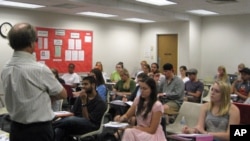
Texas' SMU is latest of 5 universities to offer human rights focus