Thailand Agrees to Hold Talks with Muslim Insurgent Group
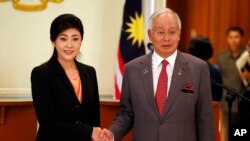
Thai Prime Minister Yingluck Shinawatra, left, and her Malaysian counterpart Najib Razak pose for photographers after their joint press conference at the latter's office in Putrajaya, Malaysia, February 28, 2013.
Thailand for the first time has agreed to hold peace talks with a major Muslim rebel group, marking a potential breakthrough in efforts to end nearly 10 years of violence in the country's south.
Senior Thai officials and representatives of the National Revolution Front meeting in the Malaysian capital on Thursday signed an agreement to start a dialogue process that will begin in two weeks.
Thai Prime Minister Yingluck Shinawatra, who met with her Malaysian counterpart in Kuala Lumpur later Thursday, said she welcomes the talks.
"The Thai authorities are willing to engage in a process of inclusive dialogue with all relevant stakeholders and groups concerned to address root causes of the problems, in accordance with the state administration and development policy for the southern border provinces and within the framework of the constitution of the Kingdom of Thailand," she said.
Thailand-Malaysia Fact Box
The National Revolution Front
Also known as Barisan Revolusi Nasional
Operates in southern Thailand
Formed in 1963, it split into three factions
Aimed to establish a pan-Malay republic
Ideology described as Islamic socialist
The Malaysia-based National Revolution Front is just one of several armed insurgent groups fighting for greater autonomy in Thailand's mainly Muslim south. It is yet to be seen whether the other groups would agree to the talks.
Malaysian Prime Minister Najib Razak said Thursday's agreement is only the start of the peace process.
"Let us hope that all parties will respect the process and not do anything untoward in the southern provinces that would undermine and jeopardize the peace process," he said.
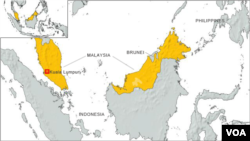
Map of Malaysia
The area has been wracked by a bloody insurgency that escalated in 2004 and has taken the lives of around 5,000 people - mostly civilians from both ethnic Thai Buddhist and Malay Muslim communities.
Thai authorities declared a state of emergency in 2005, granting the military wide powers of arrest and detention. But the emergency law has also triggered allegations of rights abuses by security forces.
Many in the south complain of discrimination by the central government. Calls by moderate Islamic groups and human rights organizations for a decentralization of power have been dismissed by security officials, who say such moves threaten national unity.
Some information for this report was provided by AP, AFP and Reuters.
The Voice of America provides news and information in more than 40 languages to an estimated weekly audience of over 326 million people. Stories with the VOA News byline are the work of multiple VOA journalists and may contain information from wire service reports.