


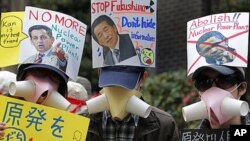
Thousands of Japanese took to the streets of Tokyo to protest the country's nuclear-power plants. The rally occured as engineers continue to work on bringing the Fukushima Daiichi plant under control, after it was smashed by last month's earthquake and tsunami.
Around 3,000 people marched through central Tokyo, a large demonstration by Japanese standards.
The rally was organized by eight civic groups to protest the Hamaoka nuclear-power plant, which is located about 200 kilometers southwest of Tokyo in Shizuoka Prefecture. Hamaoka is built in the heart of a region that seismologists believe is well overdue for a massive undersea earthquake of a magnitude 8 or higher.
The disaster at Fukushima has people worried the same thing could happen again.
Demonstrator Kengo Ohmori said his faith in the safety of nuclear power has changed. He says he has always been told nuclear power was safe, but it was not until now that he realized how dangerous it can be.
Just under a third of Japan's power output in 2005 was derived from nuclear plants, making it the largest energy source for the country. Japan's Federation of Electric Power Companies anticipates that rising to almost half the energy output by 2030.
Prior to the Fukushima accident, the country had 54 functioning reactors. Many of those marching want them all closed down. One of the protesters, Yoko Kataoka, says Japan should decommission its nuclear-power plants. She adds the country is frequently hit by earthquakes and should not rely on nuclear power in the first place.
The demonstration passed the Ministry of Economy, Trade and Industry, which promotes nuclear power and regulates the industry, and past the headquarters of Tokyo Electric Power, the utility company that owns the Fukushima plant.
Protesters delivered a noisy message at both locations.
Demonstrations were also taking place in a Tokyo suburb and two other cities in Japan.
Opposition to nuclear power had slowly been falling in Japan, before the recent disaster. A 2009 government poll found 54 percent of Japan's people were uneasy about it, down from 66 percent in 2005. The risk of accidents and earthquakes were cited as top concerns.
A new poll has not been taken since the earthquake and tsunami struck Fukushima.