



News / Asia

Three Questions: North Korea and the Internet
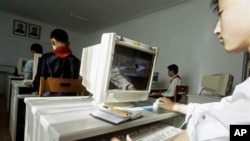
A North Korean teenager learns to use a computer which displays an image of western fighter jets at the Kumsong School, a performing arts and IT-specialist school in Pyongyang, North Korea (FILE).

North Korea traditionally has used Internet companies outside its borders to connect its websites to the world.  

But technology watchers noticed this month that a website for the official Korean Central News Agency - KCNA -  appeared to be operating from an Internet address inside North Korea.  KCNA is the first from a group of about 1,000 Internet addresses that had been set-aside for North Korea but never used.

VOA spoke with Martyn Williams, the Tokyo bureau chief for the IDG [International Data Group] News Service. He covers technology issues in Japan and South Korea.

How have North Korea's Internet habits evolved?

Recently, what we found is that North Korea appears to have started using the Internet and websites that actually are based inside North Korea.  For some time, there have been several North Korean websites on the Internet, but most of those have been run from servers in other countries, computers in China or computers in Japan have been running these sites.  A little under a year ago, North Korea started to look at how it could use the Internet itself, and it started a company with a partner in Thailand.  And they started looking towards using the Internet and recently what happened was some of the first connections from inside North Korea were connected to the Internet.

How do you know if the servers are in North Korea or not?

The first answer is that there's absolutely no way we can know for sure, but there are several things that lead us to believe that.  

The first is that the addresses the computer used are addresses that have been reserved for use by North Korea.  Some of these other websites use addresses for China or use addresses for Japan.  The websites we're talking about are using addresses for North Korea.  

Secondly, if we try to follow the traffic, follow the Internet data, it goes across the Internet.  In my case, I'm in Tokyo, so it goes from Tokyo, and it travels across the Internet and it goes into China, and then from China, there's just one more step to the computer on the North Korean Internet and that would make sense.  North Korea could only get an Internet connection from two countries, it would have to connect to China or would have to connect to Russia, because they're the two countries bordering it on the northern side, and it makes much more sense that North Korea is connected to the Internet via China. So according to all the data we have, that's what it looks like.  

It's almost sure, but like with anything on the Internet, we can't be 100% sure until we actually confirm it, and at the moment, no one in North Korea will confirm it to us.

For several years, North Korea has been very reluctant to directly connect to the Internet.  Why are they putting the official North Korean news agency on the Internet now?


This is obviously where I just start guessing, but I can probably give you several good guesses why.  

The first one would be that the KCNA website as you know is operated from Tokyo, if they operated from Pyongyang, it's much easier for them.  The KCNA staff in Pyongyang can have direct access to the computer.  Actually, if you look at the news, the news goes on the new website much faster than it goes on the Japanese website, so probably part of it is they just want to have their own website in their own office that they have complete control of.  

Secondly, I think if you look at all of the statements that North Korea said about the Internet, and also what [North Korean leader] Kim Jong Il has said about the Internet, he's said that he accesses the Internet and he uses the Internet.  I think there are many people, or some people, in North Korea that know a lot about the Internet, they're not stupid, that's why they don't allow access to the citizens.  They know that if they give ordinary people access, the ordinary people are going to find out a lot of things about the world, and a lot of things about North Korea that they never knew.

I think part of it for KCNA is just to have their own website.  Also, recently we saw that North Korea has started a Twitter feed and started You Tube and things like that.  So, maybe they're planning more websites.  They're probably not planning to give Internet access to more people in North Korea, but this is probably for information going from North Korea to the rest of the world.

You May Like

Myanmar Enters Election Year With Powerful Military Largely Unchanged

As much of the nation has undergone dramatic reform, military's dominant role in both economy and political landscape remains undiminished More

Video Israeli-Palestinian Divide Deepens in Turbulent Year

The 50-day conflict, clashes over Jerusalem holy site bode ill for 2015, analysts say More

Free-Tailed Bats Possible Source of Current Ebola Epidemic

During mission to village where current outbreak began in Guinea, researchers interviewed villagers, monitored local wildlife, captured and sampled bats More

This forum has been closed.
Comments
     
There are no comments in this forum. Be first and add one

Featured Videos

Your JavaScript is turned off or you have an old version of Adobe's Flash Player. Get the latest Flash player.
Ebola Devastates W. Africa, Horrifies World in 2014i
X
Carol Pearson
December 30, 2014 12:18 AM
The Ebola virus rampaged through West Africa in 2014 and remains a humanitarian crisis. More than 20,000 people likely have been infected by the virus, which so far has killed at least 7,842. VOA's Carol Pearson reports.
Video

Video Ebola Devastates W. Africa, Horrifies World in 2014

The Ebola virus rampaged through West Africa in 2014 and remains a humanitarian crisis. More than 20,000 people likely have been infected by the virus, which so far has killed at least 7,842. VOA's Carol Pearson reports.
Video

Video Tumultuous Year Heightens Israeli-Palestinian Tensions, Despair

A series of events in 2014 heightened tensions between Israelis and Palestinians to levels not seen in years. And the new year portends even more difficult times. VOA’s Scott Bobb reports from Jerusalem.
Video

Video Foreign Policy Battles Loom Between Obama, Republican-led Congress

Some of President Barack Obama’s loudest critics on foreign policy will have new powers as chairmen of various Senate committees when Republicans assume control of both houses of Congress in January. VOA Senate correspondent Michael Bowman reports, from Ukraine to the Middle East, the Obama administration can expect enhanced scrutiny of its outreach to the world.
Video

Video Russians Head Into Holiday Facing Economic Malaise

Russian preparations for the New Year holiday are clouded by economic recession and a tumbling currency, the ruble. Nonetheless, people in the Russian capital appear to be in a festive mood. VOA's Daniel Schearf reports from Moscow.
Video

Video Mombasa in Holiday Tourism Slump Due to Security Fears

Kenya's usually popular beachside tourist destination of Mombasa is seeing a much slower holiday season this year due to fears of insecurity as the country has suffered from a string of terror attacks linked to Somali militants. Mohammed Yusuf reports for VOA on how businessmen and tourists feel about the situation.
Video

Video For Somalis, 2014 Marked by Political Instability Within Government

While Somalia has long been torn apart by warfare and violence, this year one of the country's biggest challenges has come from within the government, as political infighting curtails the country's progress, threatens security gains and disappoints the international community. VOA's Gabe Joselow report.
Video

Video 2014 Saw Intensification of Boko Haram Insurgency

The year 2014 saw Nigerian militant sect Boko Haram intensify its five-year insurgency and target civilians in large numbers as it seized territory in the northeast. The kidnapping of nearly 300 schoolgirls in Chibok in April sparked global outrage, but failed to become the turning point against the sect that Nigeria’s president said it would be. The picture at year's end is one of devastation and uncertainty. VOA’s Anne Look reports.
Video

Video Estimates Rising of Foreign Fighters in Iraq, Syria

Foreign fighters are making more of a mark on the battles raging across Syria and Iraq than initially thought. VOA's Jeff Seldin has more.

Circumventing Censorship

An Internet Primer for Healthy Web Habits

As surveillance and censoring technologies advance, so, too, do new tools for your computer or mobile device that help protect your privacy and break through Internet censorship.
More

All About America

AppleAndroid